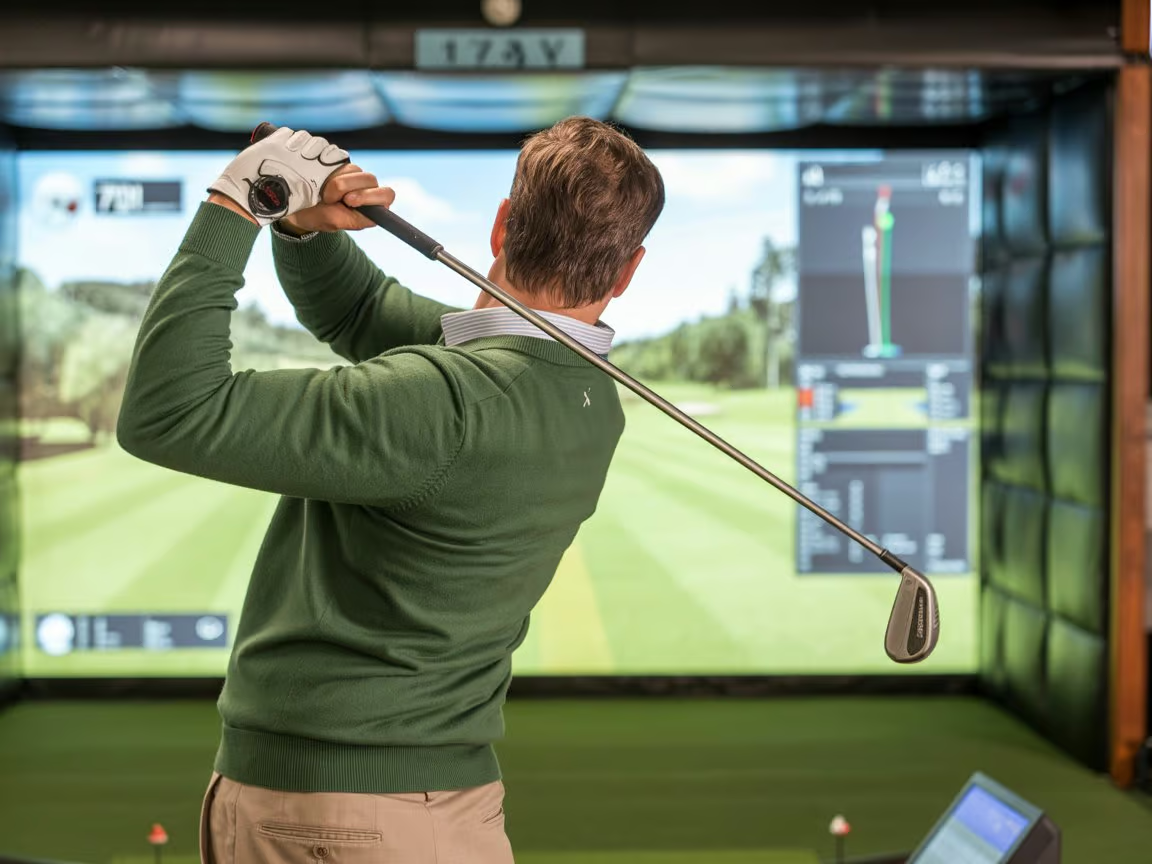

When Rory McIlroy isn’t competing on tour, he’s logging hours on his golf simulator at home. Tiger Woods credits simulator work for maintaining his swing mechanics during recovery periods. Jordan Spieth uses TrackMan data from indoor sessions to fine-tune his approach shots before major championships. [1]
Professional golfers don’t take winters off—they take their practice indoors.
For Cleveland golfers, the off-season presents a familiar challenge: how do you maintain your game when courses close and temperatures drop? The answer is the same technology PGA Tour players rely on year-round. Golf simulators have evolved from basic practice tools into sophisticated training platforms that provide the same data-driven insights professionals use to compete at the highest level.
Whether you’re an executive looking to lower your handicap before the spring season, a collegiate player preparing for tournament competition, or a retired golfer wanting to maintain your skills through the winter months, understanding how the pros use simulator technology can transform your off-season training.
In this guide, you’ll discover the specific ways PGA Tour players train with golf simulators, the technologies they rely on, and how you can apply these same techniques at The Clubhouse Cleveland in Beachwood.
Do Pro Golfers Use Golf Simulators?
Yes, professional golfers regularly use golf simulators for off-season training and year-round practice. PGA Tour players rely on simulators to:
- Maintain swing mechanics during weather disruptions or injuries
- Analyze ball flight data and club performance with TrackMan technology
- Practice specific yardages and shot shapes in controlled environments
- Prepare for tournament courses they can’t physically access
- Work on technical adjustments without the variables of outdoor conditions
Golf simulators have become standard equipment in professional training programs, with many tour players installing systems in their homes for daily practice access.

Why PGA Tour Players Choose Simulators Over Traditional Practice
Weather Independence and Consistent Training Conditions
Tour players face the same weather frustrations as recreational golfers, just with higher stakes. When preparing for a major championship and rain washes out three days of practice, simulator access becomes non-negotiable.
The consistency matters more than you’d think. On the range, every shot faces different conditions—wind shifts, temperature changes, varying grass conditions. Simulators remove those variables. If you hit the same swing twice, you get the same result. That predictability helps dial in mechanics faster than outdoor practice.
For Cleveland golfers, this advantage extends beyond winter. Spring and fall weather here is unpredictable. With simulator access at The Clubhouse Cleveland, weather never determines whether you can work on your game.
Data-Driven Performance Analysis
PGA Tour players use simulators because they provide immediate, accurate feedback outdoor practice can’t match. TrackMan shows exactly: 172 yards of carry, 3,200 RPM of spin, launch angle of 18.2 degrees. That precision changes everything about practice.
Tour players track specific metrics obsessively—club path, face angle at impact, attack angle, and dozens of data points that simulator technology captures with every swing. This level of detail helps them make micro-adjustments that add up to significant improvements.
Time Efficiency for Busy Schedules
Between tournaments, travel, sponsor obligations, and media appearances, tour players have limited practice time. Simulators maximize every minute.
A professional can work on wedge game for 45 minutes in a home simulator and get more quality repetitions than spending two hours on a practice green. The efficiency extends beyond hitting balls—want to practice Augusta National’s 12th hole? Set it up in the simulator without flying to Georgia.
For busy Cleveland professionals, this efficiency is equally valuable. Get meaningful practice during a lunch break without the drive to a course, time waiting for range space, and drive back.
The Technology Behind Professional Simulator Training
TrackMan: The Industry Standard for Tour Players
Walk into any PGA Tour player’s practice facility, and you’ll find TrackMan. Over 300 PGA Tour professionals use TrackMan technology for practice and performance analysis. [2]
TrackMan uses dual-radar technology to track every aspect of your golf ball and club, capturing data 20,000 times per second from the moment you start your downswing until the ball lands. The technology was originally developed for military applications tracking artillery, then adapted for golf.
The Clubhouse Cleveland uses the same TrackMan systems you’ll find in tour player home setups. There’s no “consumer version”—it’s identical technology measuring your swing with the same precision.
Key Metrics PGA Players Monitor During Simulator Sessions
Professional golfers track specific metrics that reveal exactly what their swing produces:
- Ball Speed – Measures strike quality and distance potential
- Launch Angle – Determines trajectory (11-13° for drivers, 16-18° for 7-irons)
- Spin Rate – Affects ball behavior in air and on greens
- Club Path – Shows direction of club movement through impact
- Face Angle – Determines starting direction and curve
- Attack Angle – Reveals whether you’re hitting down or catching it on upswing
These numbers aren’t just interesting data—they’re the foundation of how tour players practice and improve.
How Launch Monitor Data Translates to On-Course Performance
The data gathered indoors directly predicts outdoor results. If a tour player knows his 8-iron produces 7,200 RPM of spin and lands at 165 yards in the simulator, that same swing produces nearly identical results on course.
Weather and altitude affect final results, but the relationship between swing and outcome stays consistent. Tour players adjust for conditions while trusting their baseline numbers. This is why you see professionals spending hours in simulators before major championships—they’re building a database of what their swing produces under different conditions.
Five Ways PGA Tour Players Use Golf Simulators in Their Training
Swing Mechanics Refinement and Technique Work
When Bryson DeChambeau rebuilt his swing in 2020, he spent months in a simulator making micro-adjustments while watching TrackMan data change in real-time. Every modification showed immediate results in the numbers.
Simulators excel for technical work because feedback is immediate and honest. Make a grip change, and within seconds you see how it affects club path, face angle, and ball flight. No waiting, no guessing—either your numbers improved or they didn’t.
Course Preparation and Virtual Round Simulation
Jordan Spieth practiced St Andrews on his home simulator before The Open, adjusting fairway firmness and seeing different tee shot options. He played Augusta National virtually before The Masters to prepare for specific approach shots.
Modern simulator software includes photorealistic course simulations with accurate yardages, hazards, and green complexes. The visual feedback helps your brain prepare for tournament conditions. Walking up to a tee shot you’ve already hit 30 times in a simulator feels different than facing it for the first time.
Club Fitting and Equipment Testing
Equipment changes can make or break a professional’s season. When tour players test new clubs, they do it on TrackMan. The data removes all subjectivity.
Testing a new driver? Hit both drivers 20 times each and compare numbers. Which produces higher ball speed? Better launch conditions? More consistent spin rates? The simulator tells you definitively which club performs better. Tour players test everything this way—different shafts, various ball models, grip sizes. Every variable gets quantified through launch monitor data.
Questions about simulator training? Text or call us at [(216) 450-6205](tel:(216) 450-6205) to learn how our systems can help your game.
Short Game and Wedge Distance Control
Tour players practice wedge shots on simulators because they can work on specific distances repeatedly. Need to hit 73 yards exactly? Set up that distance and hit 20 shots, watching your dispersion pattern.
The spin rate feedback is particularly valuable. You can feel a good wedge shot, but the simulator shows if that shot produced enough spin to hold a firm green. Tour players adjust technique based on this feedback until they can produce needed spin rates on command.
Mental Game and Pressure Situation Practice
Tour players use simulators to practice high-pressure situations. Set up scenarios where you need birdie to win, then hit that shot 10 times. The repetition under simulated pressure builds neural pathways that activate during real competition.
The scoring aspect of simulator software adds mental elements. When you’re playing a virtual round and the screen shows you’re 2 over through 6 holes, your brain treats it similarly to actual competition.
Professional Training Routines You Can Replicate
Structure of a Typical Tour Player Simulator Session
Tour players don’t just walk in and start hitting balls. Sessions last 60-90 minutes and follow specific structures:
- Warmup (10 min) – Establish baseline numbers for the day
- Focused Practice (40-60 min) – Work on one specific element
- Challenge (10-20 min) – Competitive game or course play
The key is singular focus rather than trying to fix everything at once.
Drills and Practice Plans Used by the Pros
Dispersion Drill: Hit 20 shots trying to land every ball in a tight grouping. Tour players aim for patterns—if all 20 balls land within 15 feet of each other, that’s elite consistency.
Distance Ladder: Start at 50 yards, hit five shots. Move to 60 yards, five more. Continue to 100 yards. Shows which distances you control and which need work.
Shot Shape Progression: Hit straight, then 5-yard draw, then 10-yard draw. Work back through straight to fade. Develops ability to manipulate ball flight on command.
Tracking Progress Like a Professional
Tour players keep detailed records of simulator sessions. They’re not just practicing—they’re gathering data about their game over time.
Start by establishing baseline numbers for each club. What’s your average 7-iron carry distance? What spin rate do you typically produce? What’s your ball speed? Write these down. Three months from now, you can compare new numbers against your baseline and see actual improvement.
Track specific metrics relevant to your goals. Trying to hit the ball farther? Monitor ball speed and launch angle weekly. Working on consistency? Track your dispersion patterns. The numbers tell you whether your practice is actually working or if you need to adjust your approach.

Accessing Tour-Level Technology in Cleveland
TrackMan Systems at The Clubhouse Cleveland
The TrackMan systems at The Clubhouse Cleveland are identical to what you’ll find at PGA Tour practice facilities. The same radar technology tracking tour player ball flight is measuring yours. Ball speed, launch angle, spin rate, club path, face angle, attack angle—all measured with the same precision professionals rely on.
The simulation software includes over 200 championship courses. Want to play Pebble Beach on a Tuesday evening in February? Done. Need to practice TPC Sawgrass before a golf trip? You can walk every hole virtually before you ever arrive. Tour players use this exact feature to prepare for tournaments at unfamiliar venues.
Professional Instruction Based on PGA Training Methods
Drew Pierson, our head professional and the only TPI Level 3 certified coach in Northeast Ohio, uses the same training methodologies PGA Tour coaches employ. He’s a 10-year Class A PGA Professional who understands how to translate TrackMan data into actionable improvements for your swing.
The instruction approach mirrors what tour players experience. Start with a baseline assessment. Identify specific metrics that need improvement. Design drills targeting those areas. Practice with immediate feedback. Measure progress over time. Adjust the plan based on results.
This isn’t about copying a tour player’s swing. Your body and athletic ability are different from Brooks Koepka’s. But the training process – using data to identify weaknesses, practicing with purpose, and tracking measurable improvement – that’s universal. It works for tour players and it works for you.
The combination of tour-level technology and professional instruction creates an environment where real improvement happens. Members at The Clubhouse Cleveland aren’t just hoping they’re getting better. They’re watching their numbers improve week after week.
Membership Options for Year-Round Access
Tour players don’t practice once a month. They work on their games consistently, building skills through repetition and refinement. That same consistency drives improvement for recreational golfers.
The Clubhouse Cleveland offers membership options designed for serious players who want regular access to professional training technology. Year-round access means you never lose your game during Cleveland’s off-season. While other golfers are getting rusty from December through March, you’re maintaining or even improving your skills.
Members get priority booking on our TrackMan bays, making it easy to fit practice sessions into your schedule. Whether you prefer early morning sessions before work or evening practice after business hours, consistent access lets you build a routine that actually produces results.
Ready to Experience Tour-Level Training?
Stop wondering how PGA Tour players maintain their edge year-round. The same technology and training methods they use are available right here in Beachwood.
At The Clubhouse Cleveland, you’ll get access to professional-grade TrackMan systems, expert instruction from a Class A PGA Professional and TPI Level 3 certified coach, and year-round practice opportunities that keep your game sharp regardless of Cleveland weather.
Call (216) 450-6205 to schedule your first session or tour our facility.
Whether you’re looking to maintain your game through the off-season, prepare for competitive play, or finally break through that scoring plateau, The Clubhouse Cleveland gives you the tools tour players rely on every day.
23800 Commerce Park Rd, Suite M, Beachwood, OH 44122
How PGA Tour Players Train With Golf Simulators: Common Questions
How often do professional golfers train with golf simulators?
Professional golfers use golf simulators regularly for both off-season training and year-round practice. We see tour players rely on simulators to maintain swing mechanics during weather disruptions or injuries, analyze ball flight data with TrackMan technology, and prepare for tournament courses they can’t physically access. Many professionals have installed simulator systems in their homes for daily practice.
Which simulator systems are standard for PGA professionals?
TrackMan is the industry standard for PGA Tour players. We find TrackMan in tour player practice facilities because it uses dual-radar technology to track every aspect of ball flight and club movement, capturing data 20,000 times per second. Over 300 PGA Tour professionals use TrackMan technology for their practice and performance analysis.
What professional indoor golf leagues use simulator technology?
Tiger Woods and Rory McIlroy co-founded TGL (Tech-enabled Golf League), a simulator-based professional league that debuted in January 2025. [3] We’re seeing this innovative format combine professional competition with advanced simulator technology, allowing top players to compete indoors year-round. The league features custom-built arenas with massive screens and real turf, blending virtual golf with live putting and short game elements. This represents the future of professional golf entertainment, making the sport more accessible to fans while showcasing the same launch monitor technology that’s transformed how professionals train.
Resources
- https://www.golfdigest.com/story/heres-jordan-spieth-practicing
- https:// ngf.org/short-game/simulator-golf-sees-real-surge/
- https://www.pgatour.com/article/news/tgl/2025/01/07/the-indoor-golf-league-that-tiger-woods-and-rory-mcilroy-envisioned-finally-has-its-debut-match-tgl
- Image credit: Rory McIlroy TOUR Championship, by Cem0030, licensed under CC BY-SA 4.0.