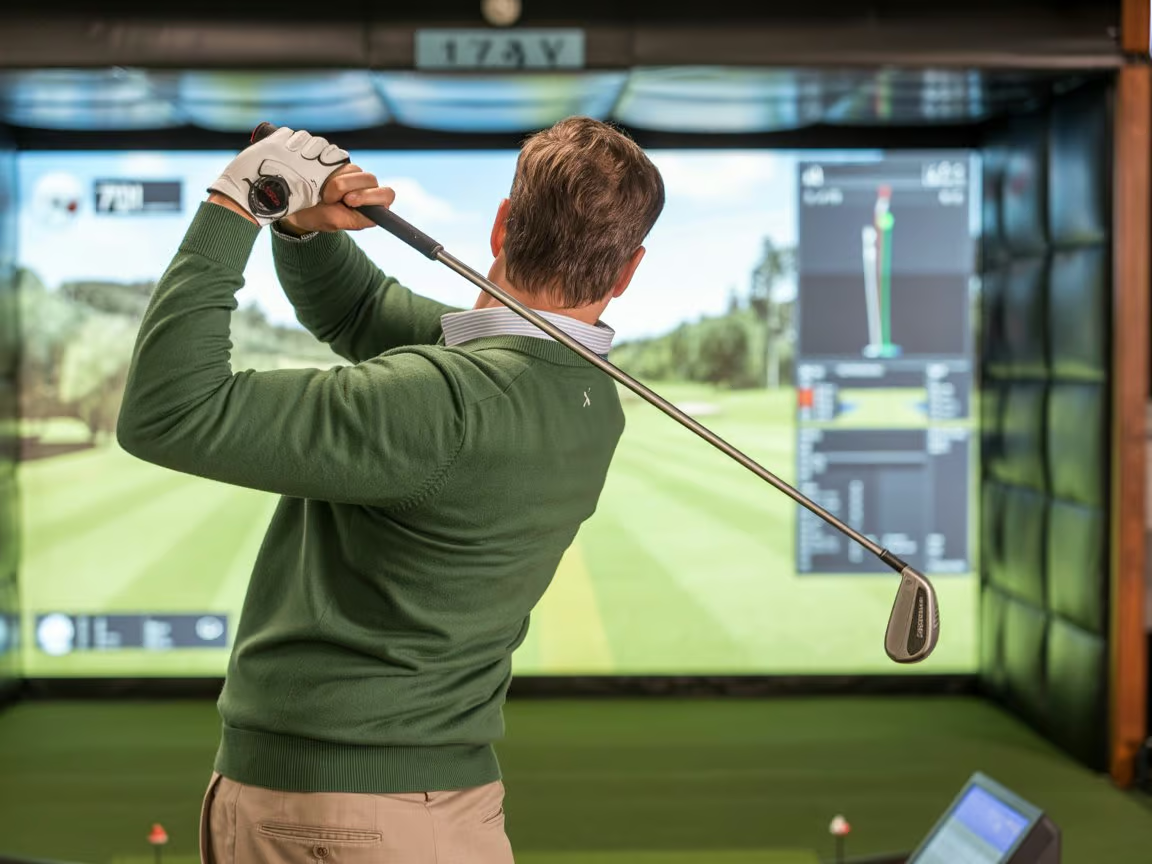

Most golfers blame their short game on nerves. PGA instructors will tell you it’s something else entirely — a missing system. Inside 100 yards, the gap between a good round and a great one comes down to one thing: knowing exactly how far each wedge swing carries the ball.
That knowledge doesn’t come from more range time alone. It comes from a structured approach built around swing mechanics, tempo, and real-time data feedback. The golfer grinding through a bucket of wedges hoping something clicks is doing the same thing week after week and wondering why nothing changes on the course.
This article breaks down the framework PGA pros use to build reliable wedge distance control — and how TrackMan technology at The Clubhouse Cleveland makes the process faster and more measurable for golfers at every level.
How Do You Control Wedge Distance Consistently?
Consistent wedge distance control comes down to three fundamentals PGA instructors teach first:
- Swing length — matching your backswing arc to a specific distance range (full, ¾, ½)
- Tempo — maintaining the same rhythm regardless of swing size
- Shaft lean at impact — controlling ball flight and spin to produce predictable carry distances
Repeating these mechanics with real-time data feedback — like TrackMan launch monitor analysis — accelerates consistency by showing exactly where each variable breaks down on every swing.
Why Most Golfers Struggle With Wedge Distance Control
Most amateur golfers practice wedges the same way — pulling out a sleeve of balls and hitting shot after shot until something feels right. The problem isn’t effort. It’s that feel-based practice without a structured framework rarely produces repeatable results on the course.
PGA instructors consistently point to three root causes of wedge inconsistency: variable swing length, inconsistent tempo, and poor impact conditions at the moment of contact. Different golfers, same underlying problem.
The PGA Method for Building Wedge Distance Control
PGA instructors approach wedge distance control in three sequential steps — and each one builds on the last.

Step 1 — Build Your Distance Ladder
PGA instructors start with one foundational concept: every golfer needs to know their exact carry distances across three swing lengths — full, ¾, and ½. This is called a distance ladder, and without one, club selection inside 100 yards is guesswork. [1] Because every golfer’s distances are unique, building an accurate ladder requires real data. TrackMan captures exact carry distance on every swing, grounding the process in numbers rather than estimates.
Step 2 — Lock In Tempo Before Distance
The most common wedge mistake is deceleration — slowing the club through impact on shorter shots, which disrupts spin, launch angle, and carry distance all at once. PGA pros address this early by teaching a consistent tempo ratio between backswing and downswing regardless of swing length. [2] TrackMan’s tempo data makes deceleration patterns visible, so instructors can correct the issue precisely rather than relying on feel alone.
Step 3 — Control Shaft Lean at Impact
Even with solid swing length and tempo, inconsistent shaft lean at impact produces unpredictable carry distances. It rarely surfaces through feel-based feedback — but it shows up immediately in TrackMan data. Spin rate and launch angle readings give instructors objective evidence to work from, which is why data-driven sessions tend to fix it faster than feel-based practice ever could. [3]
Ready to see your wedge game in real data? Book a TrackMan session at The Clubhouse Cleveland and start building your distance ladder today. Call (216) 450-6205.
How TrackMan Changes the Practice Experience
Traditional range practice gives golfers two data points: where the ball lands and how it felt. TrackMan gives them everything in between — spin rate, ball speed, launch angle, carry distance, and tempo on every swing.
At The Clubhouse Cleveland, every simulator bay runs on TrackMan technology, giving golfers access to the same professional-grade feedback system used on the PGA Tour. Class A PGA Professional Drew Pierson uses that data to build a correction plan grounded in numbers, not guesswork.
What a Session at The Clubhouse Cleveland Looks Like
At The Clubhouse Cleveland in Beachwood flexible scheduling and both session-based and membership options make it accessible without a full country club commitment. Year-round indoor access means practice and professional instruction continues, even through Cleveland winters.
A focused wedge session covers the full distance control framework:
- Distance ladder mapping across all wedges
- Tempo calibration with real-time data feedback
- Impact analysis — spin rate, launch angle, carry distance
- Shot dispersion review across swing lengths
Build a Better Wedge Game at The Clubhouse Cleveland
Wedge distance control isn’t a talent issue — it’s a system issue. And the right system, backed by TrackMan data and PGA instruction, is available year-round at The Clubhouse Cleveland. Whether you’re a busy professional looking for efficient improvement, a competitive junior chasing tighter scoring numbers, or a senior golfer adapting your game, the framework is the same. Every round without a distance ladder is another round of guesswork. Call (216) 450-6205 to book a session and find out exactly what your wedge game is capable of.
Visit us : 23800 Commerce Park Rd, Suite M, Beachwood, OH 44122

Wedge Game Questions, Answered
What causes inconsistent carry distances with wedge shots?
Inconsistent wedge carry distances almost always come down to three things: a changing backswing length, tempo that breaks down on shorter swings, and inconsistent shaft lean at impact. Any one of these will throw off your distance — and most golfers are dealing with all three. Without data feedback, these breakdowns are nearly impossible to catch on your own.
How does a wedge distance ladder work, and how do you set one up?
A wedge distance ladder maps your exact carry distances across three swing lengths — full, ¾, and ½ — for every wedge in your bag. We use TrackMan to capture carry distance on every swing so your ladder is grounded in real numbers, not estimates. Ready to build yours? Call (216) 450-6205 to book a session at The Clubhouse Cleveland.
What’s the ideal yardage gap between wedges in your bag?
Most players aim for roughly 10–15 yards between each wedge — a four-wedge setup might run 120, 105, 90, and 75 yards on full swings. Your swing speed and mechanics determine what’s right for you. A generic chart only goes so far. Knowing your actual carry distances is what turns those gaps into reliable course decisions.
Resources
- https://www.pga.com/story/dial-in-your-wedge-distances-to-lower-your-scores
- https://www.golfdigest.com/story/how-to-control-distance-wedge-shots-michael-breed
- https://www.trackman.com/blog/golf/spin-rate