

If your back tightens up on the backswing, or your hips just don’t turn the way they used to, the problem usually isn’t your technique. It’s your body. Age changes how far you can rotate, how much force you can generate, and how much strain your joints can absorb. Swinging the same way you did at 40 can leave you sore, inconsistent, or hurt.
A TPI movement screening looks at your actual physical limitations first, then builds a swing and a training plan around them. That’s how you keep playing well, and pain free, for years to come.
What is a TPI movement screen?
A TPI (Titleist Performance Institute) movement screen is a physical assessment that measures how well your body moves in the specific ways golf requires. It looks at:
- Hip and shoulder rotation
- Balance and stability
- Posture and spine angle
- Flexibility in the ankles, knees, and wrists
- Movement patterns tied to common swing faults
For golfers over 60, the results often reveal age-related restrictions, like reduced hip turn or limited shoulder flexibility, that are the real cause of swing pain or lost distance. Those results then guide swing adjustments and training built for your body.
The Physical Changes That Affect Your Swing After 60
Golf swings don’t fall apart overnight. They shift gradually as the body changes, and most of those changes have nothing to do with skill.
Hip rotation tends to decrease with age, which shortens the backswing and reduces the power you can generate through impact. Shoulder flexibility follows a similar pattern, making a full turn harder to reach without compensating somewhere else in the swing. Balance and stability decline too, and that affects how consistently you strike the ball, along with how much strain your lower back and knees absorb on every swing. [1]
None of this means you have to accept a worse game. It means the swing that worked at 40 is asking your body to do things it may not be built for anymore. Trying to force the same motion often leads to overcompensation, and that is where pain and inconsistency usually start. The fix isn’t more repetition. It’s understanding exactly where your body’s limits are now, so your swing can work with them instead of against them.

What a TPI Movement Screen Actually Measures
A TPI movement screen doesn’t start with your swing. It starts with your body. [2] The assessment tests specific movement patterns tied to golf performance, then connects each one to a common swing symptom:
- Hip rotation: limited rotation is one of the most common findings in golfers over 60, and it usually means the body is quietly rerouting power somewhere else, often straight into the lower back
- Shoulder turn: reduced turn can lead to the same kind of rerouting, another reason so many golfers in this age group report soreness after a round
- Ankle mobility: poor mobility affects weight transfer and can throw off contact consistency
- Balance: tested on one leg, tied directly to how consistently you strike the ball
- Spine posture: how well it holds through a full range of motion, tied to overall swing mechanics
Instead of guessing which of these is causing your specific issue, the screening identifies it directly, so the time you spend improving your swing goes toward the actual root cause instead of a symptom.
Not sure if age-related changes are affecting your swing? A TPI screening at The Clubhouse Cleveland can show you exactly what’s going on. Call (216) 450-6205 to get started.
How Screening Results Shape Your Swing and Training Plan
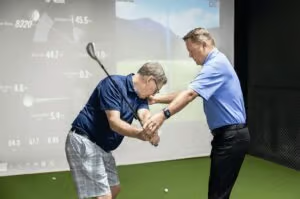
At The Clubhouse Cleveland, screenings are performed by Drew Pierson, the only TPI Level 3 Certified Golf Coach in Northeast Ohio. Once he identifies your specific limitations, the results turn into a plan built around your body instead of a generic instruction template. If hip rotation is limited, that might mean adjusting your stance or backswing length rather than pushing for a bigger turn your body can’t support. If balance is the issue, the plan might include stability work that carries over directly into more consistent contact.
This is also where TrackMan comes in. TrackMan is a launch monitor technology that tracks the physics of every shot, including clubhead speed, launch angle, and shot consistency, in real time. After a swing adjustment, that data shows whether the change is actually producing better results. Instead of relying on how a swing feels, which can be misleading, you get objective confirmation that the adjustment is working, or an early signal that something needs to change again.
The result is a plan that evolves with you. As your mobility and strength shift over time, the swing and training recommendations shift with them, which is the difference between a quick fix and something built to hold up over years of play.
Playing Pain Free and Staying Competitive as You Age
The goal of a TPI screening isn’t just fixing what hurts right now. It’s building a swing and a routine that hold up over the years ahead. That might mean keeping your handicap steady instead of watching it climb, staying competitive in your senior league, or simply getting through eighteen holes without needing to ice your back afterward.
Golf doesn’t have to get smaller as you age. With the right information about how your body moves, you can stay at a level that feels rewarding. [3] That could mean competing with old friends, passing the game on to grandchildren, or just enjoying more rounds each season without the soreness that used to follow. That’s the real win for senior golfers: more good years, not just a good round.
Ready to Build a Swing That Holds Up?
Your swing doesn’t have to keep getting harder on your body. A TPI movement screening with Drew Pierson, TPI Level 3 Certified Golf Coach and owner of The Clubhouse Cleveland, shows you exactly what’s limiting your game and how to fix it, all inside a climate-controlled facility that plays the same in January as it does in July. Call (216) 450-6205 to schedule your screening and start building a swing that holds up for years to come.

The Clubhouse Cleveland: 23800 Commerce Park Rd, Suite M, Beachwood, OH 44122
Common Questions About TPI Screenings for Senior Golfers
Will a TPI screening help me hit the ball farther, or is it just about avoiding pain?
A TPI screening helps with both distance and pain, since the two are usually connected. Limited hip rotation and shoulder turn often reroute power away from your swing, cutting distance before it ever becomes discomfort. Once you make adjustments, TrackMan measures clubhead speed and shot consistency in real time, so you see the performance gain directly.
Do I need to be dealing with pain already to benefit from a movement screening?
You don’t need to be in pain to benefit from a screening. Plenty of golfers come in before anything hurts, just looking to stay ahead of age-related changes. Catching a mobility limit early usually means a smaller adjustment now instead of a bigger fix later.
Should I improve my flexibility or fitness level before booking an assessment?
You don’t need to improve anything before booking. The screening is what tells us where your flexibility and mobility actually stand. Coming in as you are gives us the clearest picture, and we build the training plan from there. Call (216) 450-6205 to schedule your screening.
Resources
- https://www.adventhealth.com/blogs/protect-your-joint-health-feel-whole-you-age
- https://www.titleist.com/learning-lab/performance/tpi-physical-screen
- https://www.consumerreports.org/health/exercise-fitness/how-to-keep-your-body-limber-longer-a9433876188/