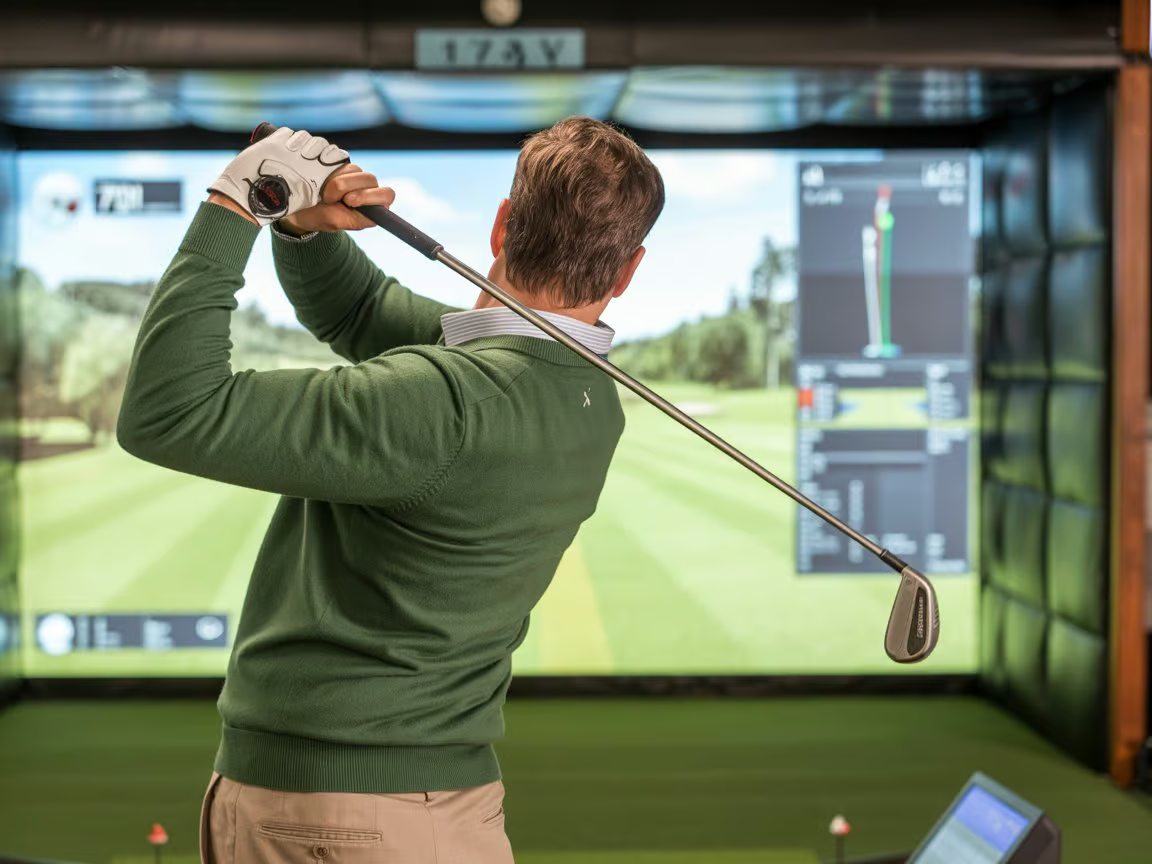

Can you fix your swing without hitting a ball? That’s the real question behind a no-ball golf simulator setup. These setups let you swing a real club at home and get instant feedback on every swing, no ball required. The price is generally low, and setup doesn’t turn into a weekend project.
When Cleveland winters shut down outdoor practice for months, that kind of convenience has real value. So is a no-ball golf simulator setup worth it? The honest answer depends on what you’re actually trying to measure. Some parts of your game translate well to no-ball practice. Others need a real ball in the air to tell you the truth. Knowing which is which helps you figure out where your practice time, and your money, should go.
What does a no-ball golf simulator measure?
A no-ball golf simulator measures your swing and club-to-surface contact, then uses that data to estimate what the shot would have done. It doesn’t measure the ball itself, so numbers like ball speed, launch angle, and spin rate are calculated guesses rather than direct readings.
What it tracks directly:
- Swing path and tempo
- Point and angle of contact on the mat
- Body motion through the swing
What it has to estimate:
- Ball speed and distance
- Launch angle and spin
- Actual shot shape (draw, fade, slice)
What a No-Ball Setup Gets Right
A no-ball setup earns its popularity honestly. It costs a fraction of a full room conversion, and setup takes minutes instead of weeks, which makes it realistic for someone who wants to keep swinging through a Cleveland winter without overhauling a budget. [1]
The practice value is real too, within its lane. Swing path, tempo, and point of contact all show up in the data these systems collect directly, so they’re well suited to drill work. Grooving a tempo change, fixing a takeaway position, or just keeping your hands from going cold for five months is exactly what a mat and a phone in the basement are built for.
It’s also low pressure. Family members can take turns, there’s no course fee, and it’s ready whenever there’s a free twenty minutes. That accessibility is often what keeps a practice habit alive over the winter instead of starting from scratch in April.
Where the Estimate Breaks Down
The gap shows up once those swings have to score. A no-ball system can tell you your tempo looked right or your path was on line. But it can’t tell you what the ball did, because there’s no ball to measure.
What a swing-based estimate can’t confirm:
- Distance, launch angle, and spin rate
- Shot shape, like a pull or a hook from a slightly closed clubface
- Wedge carry distance, where a few yards separates a good number from a bad one
A handicap stuck in the same range season after season is often explained by one of these smaller, ball-specific details rather than the overall swing. [2] This isn’t a flaw in the technology. It’s a limit of what it was built to do: convenient home repetition, not shot-level diagnostics. Knowing that difference keeps a winter of practice from feeling disconnected from the course in spring.
Want to see what your own swing data actually shows? A Trackman session at The Clubhouse Cleveland gives you real numbers, not estimates. Call (216) 450-6205 to book.
What Trackman Data Adds
This is where ball data comes back into the picture. Trackman reads the actual ball at impact, not an estimate built from the swing alone, so ball speed, launch angle, spin rate, and carry distance come from the shot itself. That’s the difference between a system telling you what probably happened and one confirming what did. [3]
For a golfer trying to fix a specific miss, that confirmation matters. A swing change can feel better and still produce the same bad shot shape, or the reverse: a shot can improve before the swing feels any different. Ball data settles the question either way, which is what separates a diagnostic session from a practice session.
Who Each Option Fits
The right setup depends on what the practice is for. A no-ball system fits anyone who wants to stay loose over the winter, keep a routine going with limited time, or work on tempo and feel without much cost. It’s a good fit for casual reps and for golfers just getting back into the game after time off.
Trackman data fits better once the goal gets specific. That’s a golfer trying to shave strokes off a handicap, fix a miss that keeps showing up on the course, or confirm a swing change is actually working before taking it into a club tournament or a client outing. It’s also useful for anyone who wants a confirmed answer instead of a feel-based one, regardless of skill level.
Most golfers end up using both. The mat handles the daily reps. Trackman handles the one question reps alone can’t answer: whether any of it is actually showing up in your shot.
Getting Real Numbers on Your Swing
So is a no-ball golf simulator setup worth it on its own? For winter reps, yes. For answering the harder questions, that’s where The Clubhouse Cleveland comes in, with Trackman simulators and a coaching staff led by Drew Pierson, a Class A PGA Professional and the only TPI Level 3 Certified coach in Northeast Ohio. Whether you’re maintaining a swing over the winter or trying to fix a specific miss before it shows up on the course, a session shows you exactly what’s happening at impact. Call (216) 450-6205 to book a Trackman evaluation or lesson, or stop by the Beachwood facility to see how the technology works firsthand.

The Clubhouse Cleveland 23800 Commerce Park Rd, Suite M, Beachwood, OH 44122
No-Ball Simulator or Trackman? Your Questions, Answered
How does a no-ball golf simulator compare to a Trackman session?
A no-ball golf simulator differs from a Trackman session in what each one measures. No-ball setups track your swing and estimate the ball’s flight, while Trackman reads the actual ball at impact, giving you real ball speed, launch angle, spin, and carry. Call (216) 450-6205 to book a Trackman session.
If I practice on a no-ball simulator, will it carry over when I get on Trackman later?
Yes, practice on a no-ball simulator carries over when moving to Trackman, especially tempo, swing path, and contact. The ball data then shows whether those habits are producing better shots. Using the mat for daily reps and booking a Trackman session to confirm the results works well.
Do Trackman simulators use a certain type of golf ball?
Indoor golf simulators don’t require a certain type of golf ball in most cases, but the ball can affect accuracy. Trackman’s TM4 radar unit works with virtually any golf ball, though Titleist RCT balls give the most accurate indoor tracking. Worn balls and novelty colors like black or pink are best avoided, since both can cause tracking problems.
Resources:
- https://golf.com/gear/best-golf-launch-monitors/
- https://www.usga.org/content/usga/home-page/articles/2024/09/average-golfer-handicap-index.html
- https://www.pgatour.com/article/news/latest/2022/02/02/pga-tour-selects-trackman-tracking-tracing-solution-beginning-in-2022