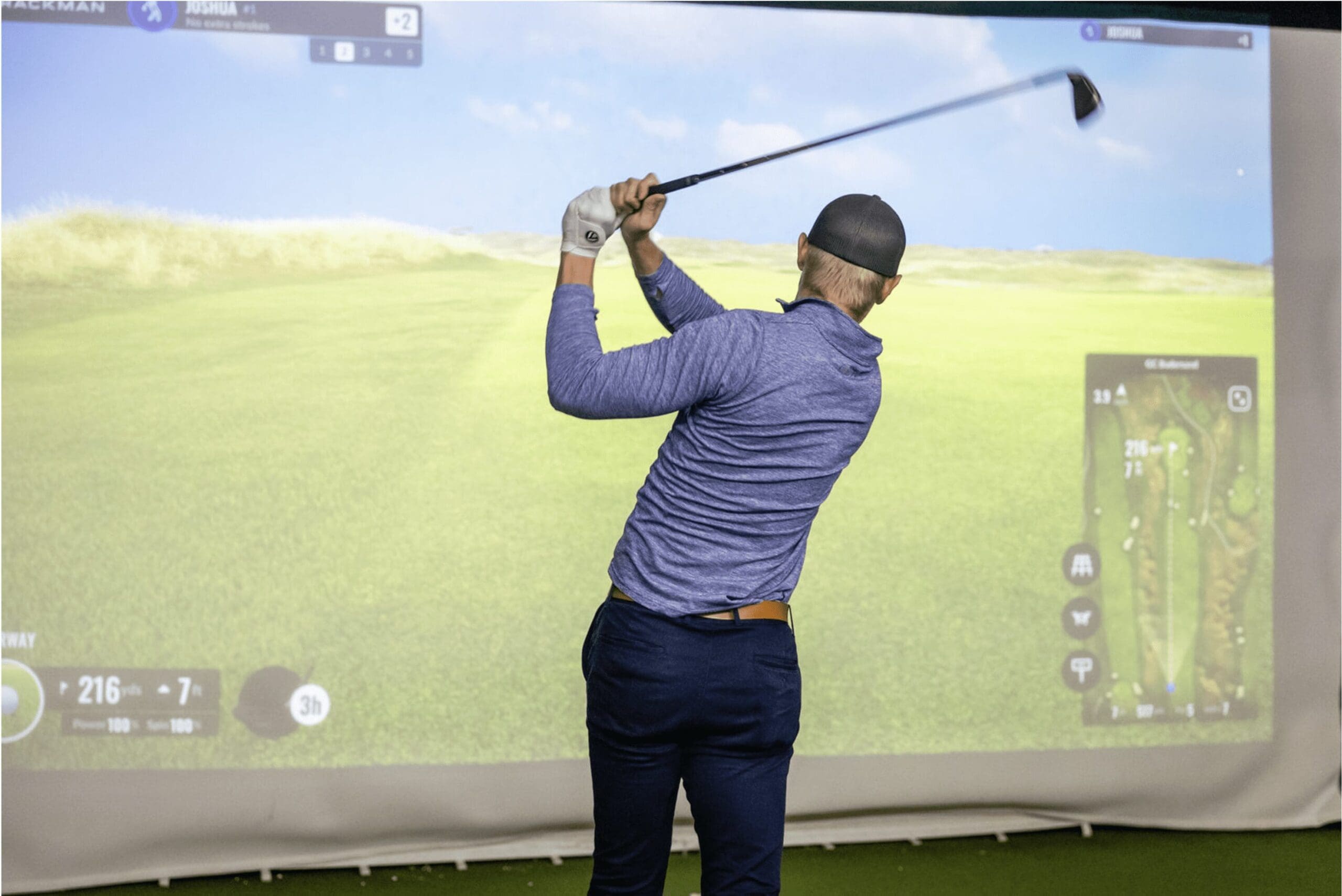

You’re standing in an indoor golf facility, watching numbers flash across a screen after each swing. Ball speed. Launch angle. Spin rate. Club path. The data looks impressive, but a nagging question crosses your mind: Can I actually trust these numbers?
For golfers investing time and money into simulator training at facilities like The Clubhouse Cleveland, accuracy isn’t just a nice feature—it’s everything. Whether you’re a business professional trying to lower your handicap before the next client outing, a competitive player preparing for tournaments during Ohio’s brutal winters, or a senior golfer fine-tuning your equipment, you need to know the technology is giving you reliable feedback.
TrackMan technology has become the recognized standard in golf simulator accuracy, trusted by PGA Tour professionals and weekend warriors alike. This article breaks down exactly how TrackMan works, what makes it accurate, how it compares to other systems, and whether the investment delivers real results for your game.
How Accurate Is the TrackMan Golf Simulator?
TrackMan golf simulators are considered industry-leading in accuracy, capturing comprehensive data that PGA Tour professionals rely on for tournament preparation. The system tracks more than 40 parameters across every shot, providing detailed feedback on both your swing mechanics and ball flight characteristics.
Club Data TrackMan 4 Measures:
- Club Speed, Attack Angle, Dynamic Loft
- Club Path, Face Angle, Face to Path
- Spin Loft, Swing Plane, Swing Direction
- Low Point, Impact Height, Impact Offset
- Dynamic Lie, Swing Radius, D Plane Tilt
Ball Data TrackMan 4 Captures:
- Ball Speed, Smash Factor, Launch Angle
- Spin Rate, Launch Direction, Spin Axis
- Height, Curve, Landing Angle
- Carry, Side, Total Distance
Putting Analysis Includes:
- Club data: Speed, Backswing Time, Stroke Length, Tempo, Attack Angle, Club Path, Face Angle
- Ball data: Launch Direction, Ball Speed, Skid Distance, Roll Speed, Break, Total Distance
- Green data: Effective Stimp, Slope percentages, Elevation
TrackMan 4 uses dual Doppler radar technology combined with a high-speed camera to track the entire ball flight from impact through landing—typically about six seconds of actual flight data. Unlike optical-based launch monitors that only capture data for a fraction of a second, TrackMan technology measures the complete ball flight in real-time rather than estimating outcomes through algorithms. [1]
What Is TrackMan Technology and How Does It Work?
TrackMan technology represents a major shift in how golfers understand their game. What started as dual radar system technology originally developed for military applications in Denmark has become the gold standard for golf performance analysis. Walk into any PGA Tour event, and you’ll see TrackMan units set up on practice ranges. [2] The reason? TrackMan captures what’s actually happening, not what algorithms think should be happening.
The Science Behind Radar-Based Ball Tracking
Here’s where TrackMan technology gets interesting. The system uses two separate radar arrays working together—one focused on your club, one locked onto the ball. While you’re taking your backswing, the first radar is already tracking your club head movement, capturing around 4,000 data points in just 0.1 seconds as it moves through the impact zone.
The moment of impact lasts about half a millisecond, and TrackMan’s capturing precise measurements at the exact moment of maximum compression. Then the second radar takes over, following your ball’s complete flight path for those full six seconds from launch to landing. This is real-time tracking of actual ball flight, measuring what the ball does rather than projecting what it might do.
Compare that to camera-based systems that only see the first fraction of a second after impact and then have to estimate the rest. TrackMan’s watching the entire show.
Key Metrics TrackMan Measures
The data breaks down into categories that tell the complete story of your shot. Club delivery metrics include speed, attack angle, club path, and face angle at impact. Through patented optically enhanced radar tracking (OERT), TrackMan 4 captures exactly where on the clubface you made contact—precision you can’t get with standard radar-only systems.
Ball flight data covers everything from ball speed and launch angle to spin rate and spin axis, which determines whether your ball curves left, right, or flies straight. The system tracks carry distance, total distance, and landing angle.
The same units at facilities like The Clubhouse Cleveland are what PGA Tour players use for tournament preparation and equipment testing. [3] Drew Pierson, owner of The Clubhouse Cleveland since 2019, selected TrackMan 4 technology specifically because it delivers the same data PGA Tour professionals use. The facility’s instructors and coaches specialize in TrackMan data analysis, helping golfers translate numbers into actionable improvements. Located at 23800 Commerce Park Rd, Suite M in Beachwood, OH, the facility offers both simulator practice and expert instruction using tournament-grade technology.
Now that you understand how TrackMan works, here’s what those numbers mean for your actual practice sessions.
TrackMan Accuracy: What the Numbers Actually Mean for Your Practice
You’re paying for simulator time because you want to get better. But here’s the thing—if the data you’re looking at isn’t accurate, you’re not practicing, you’re just guessing with extra steps. Bad data leads to bad habits, and bad habits are harder to fix than the original problem.
Understanding Measurement Tolerances
When TrackMan technology captures your club speed or spin rate, those numbers represent actual measurements, not estimates. The system’s tracking real ball flight physics through complete trajectory data, which means the feedback you’re getting reflects what actually happened on that swing. This level of precision matters when you’re trying to make specific changes to your game.
Think about it this way: if you’re working on increasing swing speed from 95 to 100 mph, you need a system accurate enough to confirm real progress versus just measurement noise. Are you actually swinging faster, or did the system just give you a different number on the same swing? With TrackMan’s real-time ball flight tracking, you can trust that a 2 mph increase means you actually gained 2 mph.
That said, no system is perfect. TrackMan requires proper setup—adequate ceiling height, correct positioning, and regular calibration. In tighter indoor spaces, some data points may be calculated rather than directly measured. The system performs best when given proper flight distance to track, which is why facility setup matters as much as the technology itself.
Why Accurate Data Matters More Than You Think
Making swing changes based on false data can send you down the wrong path for months. You might be “fixing” a club path issue that doesn’t exist, or creating new problems while chasing phantom numbers.
Equipment fitting presents real risk. If you’re selecting a driver based on inaccurate launch conditions, you could buy a club that doesn’t match your swing. When you’re spending $600 on a driver, the data guiding that decision needs to be reliable.
Then there’s wasted practice time. If you’ve got an hour to work on your game and the system tells you to address problems that don’t exist, that’s an hour you’ll never get back. Accurate data lets you focus on what actually needs improvement, making every practice session count.
With this understanding of why accuracy matters, the next question becomes: how does TrackMan stack up against other systems you might encounter?
How TrackMan Compares to Other Golf Simulator Technologies
Not all golf simulators are created equal. Walk into different facilities around Cleveland, and you’ll encounter everything from camera-based systems to infrared trackers to radar units. Understanding the differences helps you choose where to invest your practice time and money—because an hour on one system isn’t necessarily equal to an hour on another.
Camera-Based Systems vs. Radar Technology
Common Launch Monitor Types:
| System Type | Examples | How It Works | Key Advantage |
|---|---|---|---|
| Photometric/Camera | SkyTrak, Uneekor, GCQuad | High-speed cameras capture impact moment | Excellent face impact detail |
| Infrared | Various models | Light sensors track ball | Lower cost options |
| Radar | TrackMan, FlightScope | Doppler radar follows full flight | Complete ball flight measurement |
TrackMan’s Radar Technology Advantages:
- Tracks actual ball flight for 6 seconds vs. fraction-of-second camera capture
- Measures real spin axis (ball curve) rather than estimating through algorithms
- Direct measurement of carry distance and landing conditions, not projections
- Works in any lighting conditions—dawn, dusk, or indoor without special setup
- Captures complete trajectory data that translates directly outdoors
Trade-offs to Consider:
- Camera systems may excel at specific metrics like precise face impact location
- Cost differences between facility memberships with different systems
- Some systems better suited for entertainment versus serious practice
Why This Matters for Your Game Improvement
For competitive players: You need data precise enough to validate technical changes. A system that’s “close enough” can’t tell you if that swing adjustment actually reduced your club path by 2 degrees or if you’re chasing measurement error.
For business professionals: With limited practice time, inaccurate feedback wastes your most valuable resource. When you have 45 minutes to practice, you need to trust the system is identifying actual issues.
For senior golfers: Club fitting decisions based on inaccurate launch conditions can cost you distance and accuracy. When you’re already dealing with reduced swing speed, equipment mistakes based on bad data make the game harder instead of easier.
Questions to Ask When Evaluating Practice Facilities
- What launch monitor technology does the facility use?
- How often is the system calibrated?
- What’s the ceiling height and net distance? (affects trajectory capture)
- Can you access your historical data for progress tracking?
- Do teaching professionals trust the numbers for instruction?
Red flags: Facilities unwilling to discuss their technology specifics or those using consumer-grade systems for professional-priced services.
Beyond the technology itself, the question becomes: what does this level of accuracy actually mean for your specific goals?
What TrackMan Technology Means for Different Types of Golfers
Competitive Players and Collegiate Golfers
TrackMan-equipped facilities matter for serious players in ways that go beyond just having good data. NCAA coaches trust TrackMan data for remote instruction—you can send swing files to your coach anywhere in the country.
Why this matters for you:
- Compare your numbers to tour averages and established benchmarks
- Progress tracking that translates directly to outdoor tournament performance
- Remote coaching capability using industry-standard data files
- Precision that validates technical changes at elite levels
Professional and Executive Golfers
Time-starved improvers need different things from their practice technology. With 45 minutes between meetings, you can’t afford to waste time on questionable data.
What you gain:
- Confidence you’re addressing real issues, not measurement errors
- Objective feedback you can discuss credibly with instructors
- Year-round consistency that prepares you for outdoor performance
- Efficient practice when time is your most valuable resource
Senior Golfers
Accurate data becomes more valuable as physical capabilities change. Equipment optimization matters more when every yard counts.
Why accuracy matters more now:
- Distinguish technique issues from equipment mismatch
- Confidence in fitting decisions when making equipment investments
- Objective feedback as your game evolves
- Avoid expensive mistakes (wrong shaft flex can cost you distance, not gain it)
Experience the Difference for Yourself
Ready to see what your swing data reveals? The Clubhouse Cleveland’s TrackMan 4 systems provide the accuracy you need to make real improvements. Call (216) 450-6205 to book your first session or ask about membership options that fit your practice schedule.
Making Sense of Your TrackMan Data: What to Focus On
TrackMan provides more than 40 data points per shot. Here’s what actually matters for your improvement.
Priority Metrics for Most Golfers:
Focus on these four metrics first—they drive the most improvement for the widest range of golfers:
- Club speed and ball speed show your efficiency—lagging ball speed means contact issues
- Launch angle and spin rate determine distance optimization
- Club path and face angle explain why your ball curves left or right
- Attack angle affects driver distance—hitting up versus down can add 20+ yards
Using Data to Identify Your Real Issues:
Many golfers think they swing over-the-top, but TrackMan data often reveals their path is fine—they just have face control issues. That’s a completely different fix. The system helps you distinguish between swing path problems versus face control, understand consistent miss patterns, and identify whether distance loss comes from speed or efficiency.
Tracking Progress Over Time:
Access to historical TrackMan data at The Clubhouse Cleveland lets you compare today’s swing to last month’s session. You get objective validation that changes are working and can build a personal database of your optimal numbers—what launch angle gives you best carry, what spin rate produces tightest dispersion.
Ready to See What TrackMan Technology Can Do for Your Game?
TrackMan technology has changed how golfers practice and improve. The dual radar system combined with high-speed camera tracking captures more than 40 parameters per shot, measuring actual ball flight from impact through landing—the same technology PGA Tour professionals trust for tournament preparation.
Reading about TrackMan accuracy is one thing—seeing your own swing data is another. The Clubhouse Cleveland offers TrackMan-equipped simulator bays where you can get the same feedback tour players rely on. Whether you’re looking to lower your handicap, maintain your game through Ohio winters, or dial in new equipment, accurate data makes the difference between guessing and knowing.
Call (216) 450-6205 to:
- Book a simulator session to experience TrackMan technology firsthand,
- Explore membership options for year-round access, or
- Schedule a lesson with one of our certified instructors. Winter prime-time slots fill quickly—call today to secure your preferred times.
Visit The Clubhouse Cleveland at 23800 Commerce Park Rd, Suite M, Beachwood, OH 44122. Learn more at theclubhousecle.com.
Your TrackMan Technology Questions Answered
How precise is the TrackMan golf simulator?
TrackMan golf simulators deliver industry-leading precision by tracking more than 40 parameters across every shot. Our Trackman 4 simulators use dual Doppler radar technology combined with high-speed cameras to follow the complete ball flight for six seconds—measuring actual trajectory rather than estimating through algorithms like camera-only based systems.
What’s the science behind TrackMan’s ball tracking system?
TrackMan’s ball tracking system uses two separate radar arrays working together. One radar tracks your club head through the impact zone, capturing 4,000 data points in 0.1 seconds. The second radar follows your ball’s entire flight path for six full seconds, measuring real-time physics rather than projecting outcomes.
What simulator technology offers the best accuracy for golf practice?
TrackMan’s radar technology offers distinct advantages for serious practice. It tracks actual ball flight for six seconds versus the fraction-of-second capture from camera systems. This means measuring real spin axis and carry distance rather than estimating through algorithms, giving you data that translates directly to outdoor performance. Want to see Trackman 4 in action? Call The Clubhouse Cleveland at (216) 450-6205.
Resources
- https://www.trackman.com/golf/launch-monitors/tech-specs
- https://www.pgatour.com/article/news/latest/2025/08/25/pga-tour-trackman-continue-two-decade-relationship-with-renewed-agreement
- https://www.pga.com/story/making-the-most-of-launch-monitors