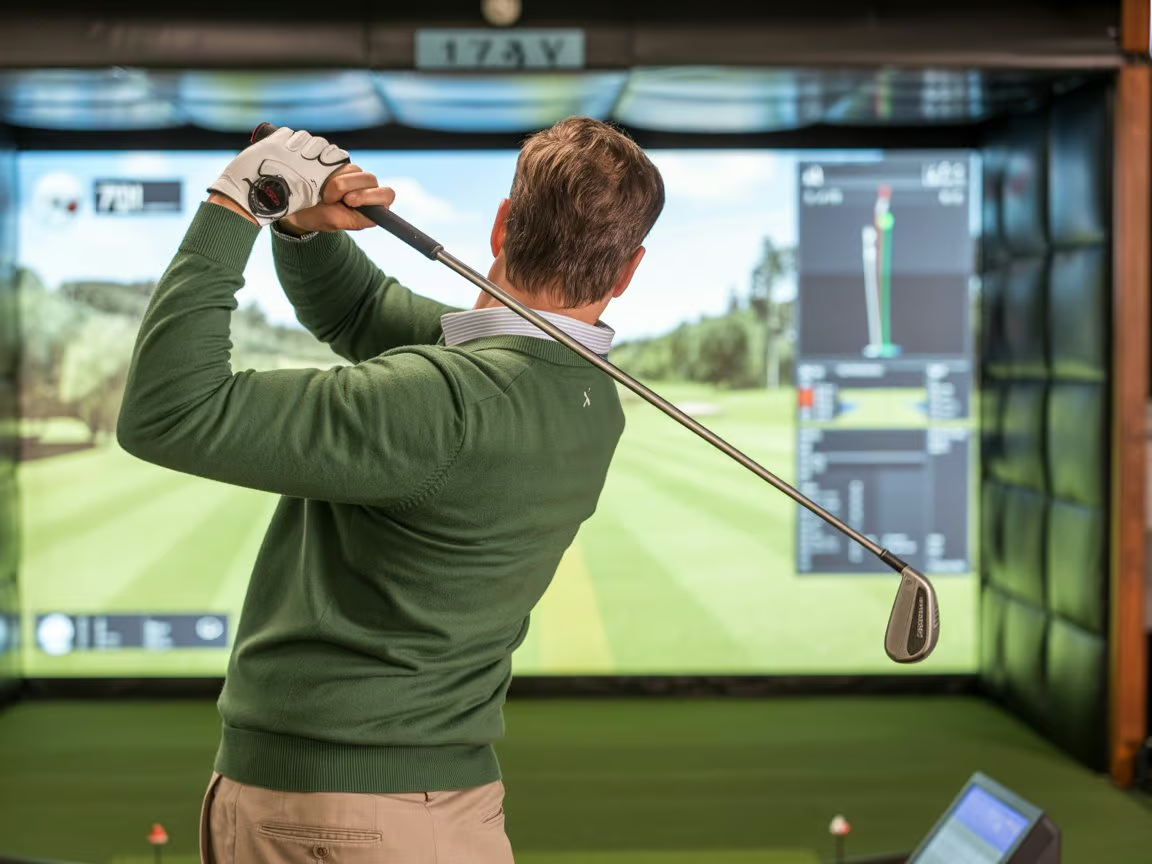

Ever hit the same swing twice and watch the launch monitor spit out two different stories? That’s not you. That’s the equipment.
Some simulators are doing actual math on your swing. Others are filling in the blanks with software guesses dressed up to look like data. And that gap between “measured” and “estimated” is bigger than most golfers realize, because a lesson built on the wrong numbers has you working on a fix for a problem you don’t actually have.
Here’s the thing: your coach can only be as good as the data they’re reading. So before you trust the advice, it helps to know where the numbers came from.
What makes Trackman more accurate than other launch monitors?
Trackman uses dual radar to track the full ball flight and club motion, not just the moment of impact. Many entry-level monitors use cameras or single sensors that measure part of the swing and estimate the rest. Here’s the difference:
- Full flight tracking: the ball’s real path, not a projected guess
- Club and ball data together: swing path, face angle, and ball speed in one swing
- Consistent indoors: dual radar isn’t affected by lighting or camera angle
Those are details a coach can actually build a lesson around.
How Inaccurate Data Leads to the Wrong Fix
Golf lessons work backward from the data. Your coach looks at what happened on a swing, spots the pattern, and builds a correction around it. If the numbers feeding that process are off, the fix can end up aimed at the wrong thing entirely.
This is exactly where the gap between launch monitors shows up. A monitor built around cameras or limited sensors often estimates spin rate and ball flight instead of measuring them directly. That can show a draw bias that isn’t really there, or miss the face angle issue that’s actually causing your slice. You leave the lesson working on a problem you don’t have, while the real one goes untouched. Weeks later the same miss shows up on the course, and it’s easy to think your swing just hasn’t improved. More often, the equipment fed the lesson bad information from the start.
That’s the quiet cost of low-quality data. Not a bad coach, just a coach working off an incomplete picture. The more directly a launch monitor measures your swing, the more a lesson can target what’s really happening instead of what the equipment assumes is happening, and that’s part of why Trackman is the launch monitor most tour players rely on. [1]

Curious what your own swing data shows? A session with Trackman at The Clubhouse Cleveland can give you clear answers. Call (216) 450-6205 to book.
What Trackman Measures That Other Monitors Miss
Trackman’s dual radar doesn’t stop tracking once the ball leaves the clubface. [2] From the same swing, it’s measuring:
- Club path and face angle at impact
- Attack angle and smash factor
- Ball speed and spin rate
Monitors that rely on cameras or partial sensors usually can’t catch all of that at once, so something gets filled in with a software estimate instead of a real measurement.
That gap matters because most misses don’t come from one isolated cause. A slice might come from an open face, an out-to-in path, or both working together in a way that cancels out on some swings and stacks up on others. Without seeing path and face angle together as actual numbers, your coach is stuck guessing which one to fix first. With both measured directly, the correction can target the combination causing the miss instead of a generic fix that helps one golfer and does nothing for the next.
It also changes how your lessons progress over time. Instead of going off how a shot looked or felt, your coach can compare this month’s numbers to last month’s using data that was measured, not approximated, and show you whether the change is working.

Why Data Quality Changes What You Can Trust From a Lesson
Every golfer’s heard a coach say “close enough” after a swing, and sometimes it is. But at an indoor facility, where the launch monitor is doing the work a trained eye would normally do outdoors, close enough can be the difference between a fix that works and one that doesn’t.
This is the real comparison to make when you’re choosing where to practice or take lessons: not just which facility has a simulator, but which simulator is accurately measuring your swing versus approximating it. A monitor that rounds off spin rate or estimates face angle isn’t wrong often enough to be obvious, which is exactly what makes it risky. The errors are small and inconsistent, so you have no way of knowing which numbers to trust and which to question.
With Trackman, that uncertainty goes away. The numbers your coach points to are the numbers that actually happened on that swing, which means every adjustment in a lesson is built on something verifiable instead of assumed. [3] That’s what turns the time and money you’re putting into getting better into a lesson that actually moves the needle, instead of one that just feels productive.
Ready to See Your Real Numbers?
Golf lessons are only as good as the data behind them. At The Clubhouse Cleveland, that data comes from Trackman, interpreted by a coaching team led by Drew Pierson, the only TPI Level 3 Certified Coach in Northeast Ohio and a Class A PGA Professional. If you’ve been working on your game without seeing the results you expect, the issue might not be your swing. Call (216) 450-6205 or visit The Clubhouse Cleveland to book a session and see what your numbers look like.
The Clubhouse Cleveland 23800 Commerce Park Rd, Suite M, Beachwood, OH 44122
Trackman and Your Golf Lessons: Common Questions Answered
Do Trackman numbers really shape how a golf lesson is taught, or are they just something nice to look at?
Trackman numbers really do shape how a lesson is taught, not just something nice to look at. Because club path and face angle are measured directly, your coach can target the cause of a miss instead of a guess, and compare this month’s numbers to last month’s to show whether a change is working.
My game has stalled after years of playing. Could unreliable launch monitor numbers be holding me back?
Unreliable launch monitor numbers could be exactly what’s holding your game back. If a monitor estimates spin or misses a face angle issue, you end up fixing a problem you don’t have while the real one goes untouched. That stall might not be a swing problem at all. Call (216) 450-6205 to find your numbers.
What sets Trackman apart from the simulators you find at a gym or a retail store?
What sets Trackman apart is how much of the swing it actually measures instead of estimates. Most gym and retail setups give you a quick swing speed reading off partial sensor data, so results can shift session to session even when your swing hasn’t changed. Trackman measures, it doesn’t guess.
Resources:
- https://golf.com/instruction/driving/this-is-how-far-pga-and-lpga-tour-players-hit-it-with-every-club/
- https://www.nationalclubgolfer.com/reviews/kit/tech-talk-how-does-trackman-work/
- https://golfrange.org/trackman-blending-teaching-and-technology/