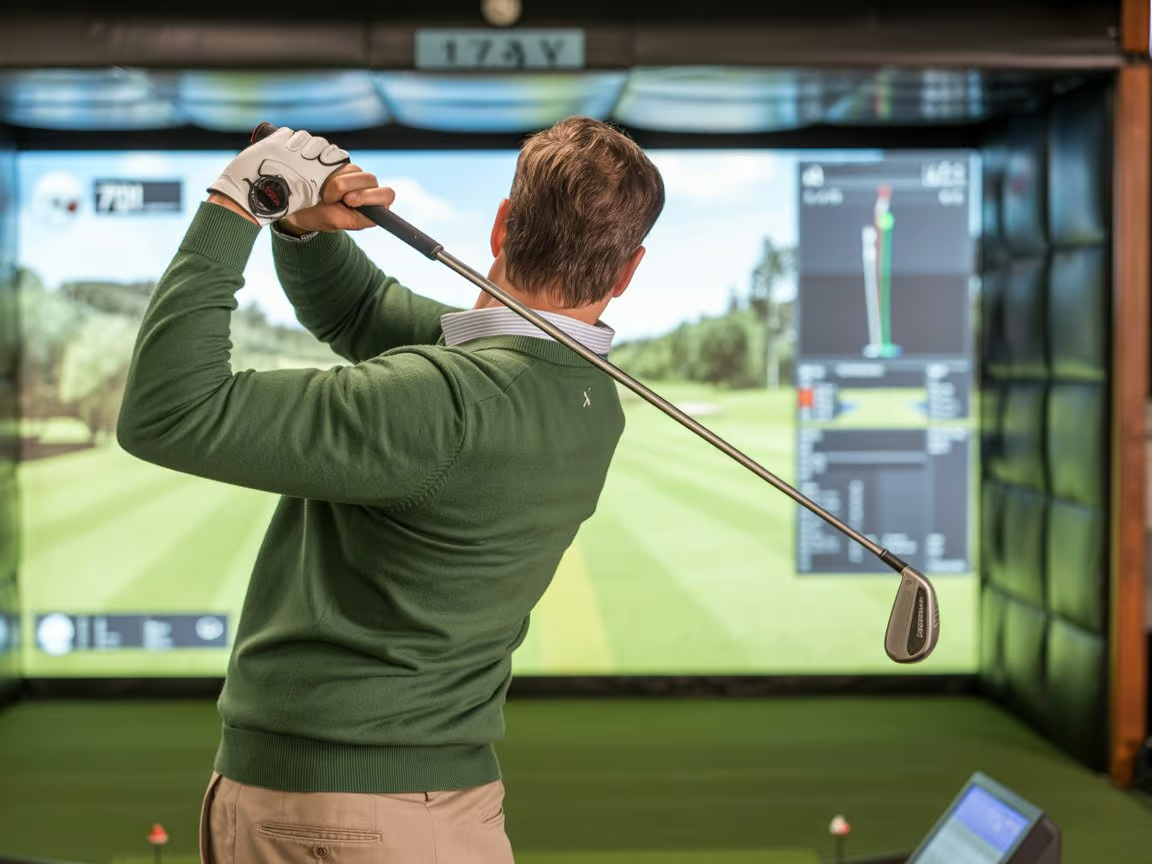

Golf instruction has changed dramatically over the past decade. [1] Walk into any modern teaching facility, and you’ll find PGA professionals spending more time indoors with simulators than on traditional driving ranges. This shift isn’t about convenience or weather protection—it’s about results.
At The Clubhouse Cleveland in Beachwood, 10-year Class A PGA Professional Drew Pierson has witnessed this transformation firsthand. “The simulator gives me information in seconds that used to take weeks of observation to gather,” he explains. “I can show a student exactly what their club is doing at impact, and we can measure improvement in real-time.”
This data-driven approach is reshaping how golf professionals teach at every level—from executives looking to drop their handicap before a client outing, to collegiate players chasing scholarship opportunities, to retirees adapting their swing for changing physical abilities.
In this article, you’ll discover why PGA professionals across the country are choosing simulator-based instruction, what specific advantages this technology offers over traditional teaching methods, and how systems like TrackMan are setting new standards for golf improvement. Whether you’re considering lessons for the first time or looking to accelerate your development, understanding this shift will help you make smarter training decisions.
Do pro golfers use golf simulators?
Yes, professional golfers regularly use golf simulators for practice and instruction. Tour players rely on simulator technology to:
- Analyze precise swing data (club speed, path, face angle, spin rates)
- Practice during off-season or inclement weather
- Fine-tune specific shots with immediate feedback
- Test equipment changes before tournament play
- Work with coaches using measurable data points
Systems like TrackMan have become standard tools on professional tours, providing the same launch monitor technology used during PGA Tour broadcasts. This professional-grade data allows both tour players and everyday golfers to practice with unprecedented accuracy and insight.
The Evolution of Golf Instruction Technology
From Video Analysis to Real-Time Data
Twenty years ago, golf instruction relied on what the teaching professional could see. Video cameras added replay capability, but video only shows what happened—not why the ball flew that direction or what the club was actually doing at impact.
Launch monitors changed everything. [2] These devices measure exactly what’s happening: club speed, path, face angle, spin rate, launch angle. Within seconds, you know precisely why the ball curved or came up short. The guesswork disappears.
The real revolution happened when this technology became affordable for teaching facilities. What was once reserved for tour players became accessible to everyday golfers, transforming the student-teacher relationship from “trust me” to “here’s what the data shows.”
How PGA Professionals Now Use Technology:
- Over 75% of teaching professionals regularly use launch monitor technology
- Top-ranked instructors report 90%+ adoption rates
- Facilities integrate simulators as primary teaching tools rather than supplements
- Data tracking allows comparison of sessions across weeks and months
At The Clubhouse Cleveland, every lesson happens with TrackMan running. Drew can pull up a student’s session from three months ago and compare it to today’s numbers—objective tracking that’s impossible on a driving range where balls disappear into the distance.
The Data Advantage: What Simulators Reveal That the Eye Cannot
Here’s something most golfers get wrong: they think club path determines where the ball goes. Actually, ball flight is 75-85% determined by where your club face is pointing at impact, and only 15-25% by path. This isn’t opinion—it’s physics that launch monitors have proven through millions of measured shots.
Drew sees this constantly. “A student will slice the ball right and tell me they’re swinging outside-in. Sometimes they are. But just as often, their path is fine—it’s an open club face creating the slice. Without data, we’d spend weeks working on the wrong thing.”
What TrackMan Measures at Impact:
- Club speed and ball speed
- Attack angle and dynamic loft
- Club path and face angle
- Face-to-path relationship
- Spin rate and spin axis
- Launch angle and direction
- Carry and total distance
The simulator shows both numbers immediately. Club path: 2 degrees in-to-out. Club face: 4 degrees open. Now you know exactly what needs work. You’re not guessing, you’re measuring the actual problem.
Understanding Consistency Through Dispersion
Average distance lies. A golfer who hits eight shots that carry 150 yards and two shots that carry 130 yards has an average of 146 yards. But that average is meaningless when one out of every five shots comes up 20 yards short.
Dispersion patterns reveal the truth. The simulator tracks where every shot would land and creates a heat map of your results. You might discover your misses are consistent—everything offline goes left, nothing right. That’s a pattern you can fix. Random scatter in all directions suggests fundamental swing inconsistency.
The outdoor range can’t tell you any of this. You hit shots, watch where they land, estimate results. The simulator gives exact numbers for every single swing.
Faster Feedback Loops Create Faster Improvement
Your brain learns motor skills through repetition paired with feedback. Research on motor learning consistently shows that immediate feedback accelerates skill acquisition by 30-40% compared to delayed feedback. When you know instantly whether a movement worked, your brain associates the feeling with the result. Wait even a few seconds, and that connection weakens.
A study published in the Journal of Motor Learning demonstrates how real-time performance feedback significantly improves skill retention compared to delayed or summary feedback methods.
On a traditional range, feedback is slow and imprecise. You hit a shot, watch the ball flight, estimate where it landed. The golf simulator eliminates that delay—before your follow-through finishes, exact results appear on screen.
Practice Efficiency Comparison:
| Traditional Range Session | Simulator Session |
|---|---|
| 10 min: Setup, warmup | 5 min: Setup, warmup |
| 40 min: Hitting 60-80 balls | 45 min: Hitting 40-60 shots |
| 10 min: Cleanup | 10 min: Data review, goal setting |
| Result: Subjective assessment | Result: Complete data profile, measurable metrics |
The simulator session involves fewer total swings but higher-quality practice. Each shot matters because you’re measuring it. You can test a swing change for five shots, see exactly how it affected your numbers, and decide whether to keep working on it.
Drew structures lessons around this feedback loop. “We’ll identify one or two key numbers to improve—maybe shallow out the attack angle or increase club speed by 3 mph. Then we work on changes that move those numbers in the right direction. The student sees progress happening shot by shot.”
Ready to see what TrackMan data reveals about your swing? Learn more about lesson packages and membership options at The Clubhouse Cleveland. Call (216) 450-6205

Year-Round Consistency in Northeast Ohio’s Climate
Cleveland averages 45 days per year with temperatures below 32°F, limiting outdoor practice from November through March. That’s nearly five months when most golfers put their clubs away and watch their skills deteriorate.
The gap shows up every spring. Golfers who haven’t touched a club since October head to the course in April expecting to pick up where they left off. Instead, they’re scoring five to seven strokes worse. The rust isn’t just mental—swing mechanics, touch around greens, distance control all regress without practice.
Environmental Factors Affecting Outdoor Practice:
- Temperature affects ball flight (~2 yards per 100 yards difference between 50°F and 90°F)
- Wind creates inconsistent ball flight data
- Humidity and altitude change distance
- Ground firmness affects landing results
- Weather interruptions limit practice time
The Clubhouse Cleveland’s indoor facility solves this problem. While snow piles up outside, golfers hit full shots with their driver, work on approach accuracy, practice short game. The controlled environment means consistent practice year-round.
Drew sees the difference in students who practice through winter versus those who don’t. “The guys who come in once or twice a week all winter—they show up ready to play in spring. They’re not shaking off rust, they’re continuing to improve.”
Located at 23800 Commerce Park Rd in Beachwood, the facility is easily accessible from Shaker Heights, Pepper Pike, and Cleveland’s east side. You’re not driving an hour—you’re stopping in after work at a facility ten minutes away.
Don’t let Cleveland winters stall your golf improvement. The Clubhouse Cleveland offers year-round access to TrackMan simulator technology. Schedule a tour of our Beachwood facility at (216) 450-6205.
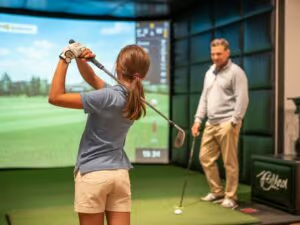
Customized Instruction for Different Skill Levels
Beginners: Building Fundamentals with Objective Feedback
New golfers don’t yet know what a good swing should feel like. Without a reference point, they develop bad habits that become ingrained. The golf simulator gives beginners objective feedback that prevents this problem.
A new student might make contact that feels decent and see the ball fly reasonably straight. Without data, they’d assume that swing works. But TrackMan might show an over-the-top path paired with a closed face—two flaws that temporarily cancel each other out. The simulator catches these issues early before they become ingrained patterns.
Starting with good data also builds confidence faster. Simulator practice provides measurable progress—club speed increases by 4 mph over three sessions, contact consistency improves from 60% to 85%, dispersion patterns tighten up. Those numbers prove you’re getting better.
Competitive Players: Fine-Tuning for Performance Gains
Serious golfers don’t need to learn how to hit the ball—they need to optimize performance. A collegiate player preparing for championships, a competitive amateur trying to qualify for state events—these golfers measure success in marginal gains.
The simulator provides the precision these players need. Drew works with competitive golfers on specific metrics that translate to lower scores: attack angle optimization for driver distance, spin rate control for approach shots, dispersion pattern improvement for hitting more greens.
Speed training programs run particularly well on golf simulators. TrackMan’s speed radar shows club speed in real-time, letting competitive players push their limits while maintaining control. Equipment testing matters too—a half-degree loft change can affect ball flight significantly. The simulator lets players test equipment and see exact performance differences.
Senior Golfers: Adapting to Physical Changes
Golf after 60 looks different. Flexibility decreases. Swing speed drops. But that doesn’t mean you can’t play well—you need to adapt technique and equipment to current physical abilities.
The golf simulator reveals exactly how physical changes affect performance. Drew works with retired golfers who want to maintain their handicaps despite losing 15-20 mph of club speed. The data shows where adjustments help most—a senior golfer might discover they’re launching too low now that swing speed has decreased. Changing to a driver with more loft optimizes launch angle and recovers distance.
Club fitting becomes more important as you age. Lighter shafts might increase swing speed. Higher-lofted fairway woods might replace long irons that no longer launch properly. The controlled indoor environment also matters—older golfers struggle with temperature extremes. Year-round indoor practice at comfortable temperatures means consistent training without weather-related discomfort.
Serious about taking your game to the next level? Ask about specialized training programs including speed development and competitive preparation. Call (216) 450-6205
TrackMan Technology: The Professional Standard
Walk into any PGA Tour event and you’ll see TrackMan units stationed behind practice range bays. Pull up a tournament broadcast and announcers reference TrackMan data. This isn’t marketing—it’s the actual technology that professional golf relies on.
TrackMan Accuracy Specifications:
- Ball speed: within 0.1 mph
- Launch angle: within 0.1 degrees
- Spin rate: within 50 RPM
- Club speed: within 0.1 mph
- Attack angle: within 0.1 degrees
That precision level makes it trusted for equipment testing by Titleist, Callaway, and TaylorMade. [3] When companies need to validate that a new driver actually performs as claimed, they use TrackMan data to prove it. Used by 95% of PGA Tour players and featured in every major championship broadcast, TrackMan has become the industry standard.
Teaching professionals followed tour players’ lead. The PGA of America now incorporates launch monitor technology into teaching certification programs. Drew’s experience spans both eras. “I learned to teach watching ball flight and using video. Those skills still matter—but TrackMan adds certainty that observation alone can’t match. I know exactly what’s happening at impact, every single time.”

Professional-Grade Technology at The Clubhouse Cleveland
The same TrackMan technology used by tour players runs at The Clubhouse Cleveland in Beachwood. Not a consumer-grade simulator. Not a budget launch monitor. The actual professional system that measures every aspect of club and ball performance.
This matters because data quality affects instruction quality. When Drew tells a student their club path needs to move two degrees, that recommendation is based on measurements accurate to a tenth of a degree. The adjustments work because the underlying data is reliable.
Drew’s 10 years as a Class A PGA Professional combined with TrackMan technology creates an instruction environment matching what tour players receive. You’re getting data-driven feedback from someone who understands both the numbers and how to translate them into swing changes that work on the course.
Experience the Data Advantage at The Clubhouse Cleveland
Golf improvement shouldn’t be guesswork. At The Clubhouse Cleveland, you’ll discover exactly what your swing is doing—and more importantly, what changes will lower your scores fastest.
For busy professionals: Stop wasting range time hoping you’re improving. Get measurable data that shows what’s working in sessions that fit your schedule. Evening and weekend slots available at our Beachwood location—ten minutes from your office, not an hour drive to a course.
For competitive players: Tour-level TrackMan data reveals the 2-3% gains that separate good players from great ones. Speed training, launch optimization, dispersion analysis—the same technology college and professional players use for performance gains.
For golfers over 60: Adapt your game to work with your current abilities, not against them. Drew’s equipment fitting and swing modifications help you maintain—or even improve—your handicap despite physical changes that come with age.
Drew Pierson brings 10 years of PGA Professional expertise plus technology that measures every swing with tour-level precision. You’ll see exactly what needs to change, measure whether it’s working, and track improvement with data that doesn’t lie.
Cleveland winters don’t have to mean five months of regression. Practice year-round in climate-controlled comfort. Build skills in January that show up as lower scores in April.
Take the First Step
Call (216) 450-6205 to schedule your first session
Stop by for a tour: 23800 Commerce Park Rd, Suite M, Beachwood, OH 44122
Convenient to Shaker Heights, Pepper Pike, and Cleveland’s east side. Open year-round with flexible scheduling that works around your life.
The data is clear. The technology is proven. Your improvement starts with one decision.
Common Questions About Simulator-Based Golf Instruction
Is simulator-based golf instruction worth the investment?
We believe simulator-based instruction delivers exceptional value because it eliminates guesswork and accelerates improvement. Research shows immediate feedback improves skill acquisition by 30-40% compared to delayed feedback. You’ll get tour-level data showing exactly what your swing is doing, measure progress objectively across sessions, and practice year-round regardless of weather—benefits that traditional range sessions simply can’t match.
Do professional golfers practice with simulator technology?
Professional golfers regularly use simulators for practice and instruction. Tour players rely on this technology to analyze precise swing data including club speed, path, face angle, and spin rates. Systems like TrackMan are used by 95% of PGA Tour players and appear in every major championship broadcast. The same professional-grade technology that tour players use for equipment testing and tournament preparation is what we use for everyday instruction.
Can golf simulator practice actually improve your game?
Simulator practice accelerates improvement through immediate, precise feedback that outdoor range sessions can’t provide. Your brain learns motor skills faster when you know instantly whether a movement worked. Each shot gives you exact data on club speed, path, face angle, spin rate, and dispersion patterns. We can identify one or two key metrics to improve, test swing changes for five shots, see exactly how they affect your numbers, and decide whether to continue working on them.
Resources
- https://www.golfdigest.com/story/youll-be-singing-radar-love-when-you-check-out-the-new-version-of-trackman
- https://books.forbes.com/author-podcasts/into-the-singleverse/how-data-and-analytics-are-changing-golf-with-padraig-harrington-part-one/
- https://www.trackman.com/blog/golf/titleist-to-launch-balls-optimized-for-trackman-indoor-use