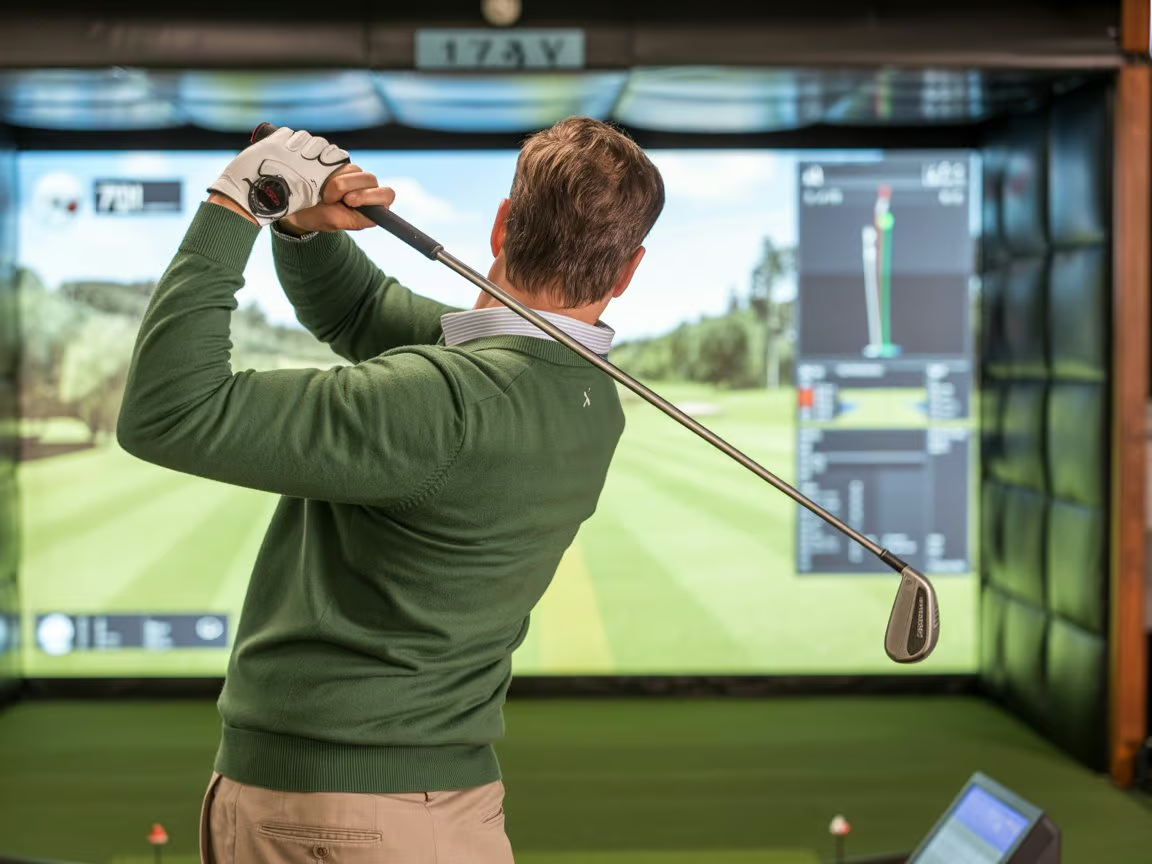

Most golfers who get stuck at the same handicap aren’t short on effort. They play when they can, practice when the weather cooperates, and maybe buy a new driver along the way. And still, the number barely budges.
The problem usually isn’t how hard you’re working. It’s that you’re guessing at what to fix. Feel just isn’t a reliable coach, especially coming out of a long Cleveland winter. At The Clubhouse Cleveland in Beachwood, TrackMan measures what actually happens on every swing, from club path to face angle at impact. Once you see why your handicap isn’t dropping and what TrackMan data reveals about your swing, you can stop practicing the wrong things and start working on what’s really costing you strokes.
Why is my handicap not going down?
Most handicaps stop dropping because golfers practice without accurate feedback. Without data, it’s hard to tell which part of your game is costing you the most strokes. The most common causes are:
- Practicing on feel instead of measured results
- Inconsistent clubface control at impact
- Focusing on the driver while overlooking approach shots
- Using equipment that doesn’t fit your current swing
- Losing skills during the off-season
TrackMan data helps pinpoint which of these is costing you the most.
Why Practicing on Feel Keeps Your Handicap Stuck
Hitting a bucket of balls feels productive. But if you don’t know why a shot went where it did, every rep is a guess. And repeating a guess can reinforce the same mistake you’re trying to fix.
Feel can also be misleading. What you sense in your swing often doesn’t match what the club is actually doing. A golfer fighting a slice might spend a whole season working on swing path when the real issue is an open clubface at impact. The effort is real. It’s just aimed at the wrong problem.
What a Launch Monitor Adds to Your Practice
TrackMan is a radar-based launch monitor that tracks both the club and the ball on every swing. Within seconds, it shows numbers like club speed, ball speed, launch angle, spin rate, and carry distance. [1] Instead of wondering whether a change worked, you can see it in the data and compare it to your last ten swings.
That turns practice from guesswork into a clear feedback loop: make a change, check the numbers, keep what works.
What TrackMan Data Reveals About Your Clubface and Ball Flight
Many misses come down to where the clubface points at impact. Even a slightly open or closed face can send the ball well off line, and it happens too fast for you to see with the naked eye. TrackMan can see it, breaking the moment of impact down into numbers like these:
- Face angle: where the clubface points at impact, and the biggest factor in where the ball starts
- Club path: the direction the club is traveling through impact
- Face-to-path: the gap between the two, which determines how much the ball curves
- Smash factor: how efficiently your club speed converts into ball speed
TrackMan says golfers should aim for a smash factor near 1.50 with a driver. [2] Higher-lofted clubs naturally run lower, so a pitching wedge should sit closer to 1.25. A number well below those marks often points to contact away from the center of the face, which costs distance even on swings that feel solid.

Seeing these numbers side by side also shows your patterns. One great shot doesn’t lower a handicap. A tighter spread of shots does.
Ready to see your own numbers? A session with the coaching team at The Clubhouse Cleveland pairs TrackMan data with hands-on instruction. Call (216) 450-6205 to schedule.
Approach Shots Are Where Many Handicaps Stall
Golfers tend to spend the most practice time on the driver, but the shots that often decide a round happen in the middle of the hole. Full swings with your irons and wedges set up how many putts you’re left with, and how many strokes slip away before you ever reach the green.
Dialing in Your Approach Distances
TrackMan measures carry distance on every shot, including partial swings. Hit a set of wedges and mid-irons, and you’ll see exactly how far each one carries and how consistent that distance is. You may find gaps between clubs you didn’t know existed, two clubs that carry nearly the same distance, or a pattern of coming up short on a specific number.
Once you know those numbers, you stop guessing on approach shots. You pick a club and a swing you trust, and you leave yourself shorter putts more often. For a lot of golfers, tightening up approach play closes more strokes than chasing extra distance off the tee.

How Equipment and Cleveland Winters Hold Your Scores Back
Even with a sound swing, the wrong equipment can cap your progress. A driver that doesn’t match your swing speed, or a set of irons with the wrong lie angle, can undo work you’ve put in elsewhere. TrackMan data shows these issues clearly, since the same swing can produce very different results depending on what’s in your hands.
Weather adds another obstacle. A Cleveland winter can mean months away from a golf course, and skills built over the summer tend to fade without regular use. The Clubhouse Cleveland’s indoor simulators keep that work going year-round, so you’re not starting over every spring.
Getting the Right Guidance Behind the Data
Numbers point you toward a problem. Turning that into a lower handicap takes an instructor who can read them and build a plan around what they show. At The Clubhouse Cleveland, the coaching team is led by owner Drew Pierson, the only TPI Level 3 Certified Coach in Northeast Ohio. [3] That expertise means your swing gets evaluated for both technique and the physical mechanics behind it, so the fix addresses the actual cause rather than a symptom.

Ready to See the Data Behind Your Swing?
Your handicap isn’t stuck because you’re not trying. It’s stuck because you haven’t seen the data behind your own swing. At The Clubhouse Cleveland in Beachwood, TrackMan technology shows you exactly where strokes are slipping away, and Drew Pierson, a Class A PGA Professional, leads a coaching team that turns that data into a plan you can actually use. Call (216) 450-6205 to schedule your session.
The Clubhouse Cleveland: 23800 Commerce Park Rd, Suite M, Beachwood, OH 44122
Handicap and TrackMan FAQs
Could ill-fitting clubs be the reason my scores aren’t improving?
Yes, ill-fitting clubs can be part of why your scores have stalled. Equipment that doesn’t match your swing speed or body mechanics can quietly work against you, even when your technique is solid. A TrackMan session shows whether the problem is really your swing or the clubs in your hands, so you’re not fixing something that was never broken.
How does carry distance differ from total distance on a golf shot?
Carry distance is how far the ball flies in the air before it lands. Total distance is carry plus the roll after it touches down. Carry is the number worth watching, since roll changes with turf, firmness, and weather, while carry tells you how far a club really goes. TrackMan measures carry on every shot.
What causes my distances to vary from one round to the next when my swing feels unchanged?
Distance changes from round to round because small things shift even when your swing feels the same, like where the ball meets the face, the weather, ground firmness, and ball condition. Off-center contact is the first thing worth checking. A low smash factor on TrackMan is one of the first clues. Curious what your own numbers show? Call (216) 450-6205.
Resources:
- https://www.nationalclubgolfer.com/reviews/kit/tech-talk-how-does-trackman-work/
- https://www.trackman.com/blog/smash-factor
- https://www.kansashealthsystem.com/news-room/blog/0001/01/tpi-certification-for-golfers