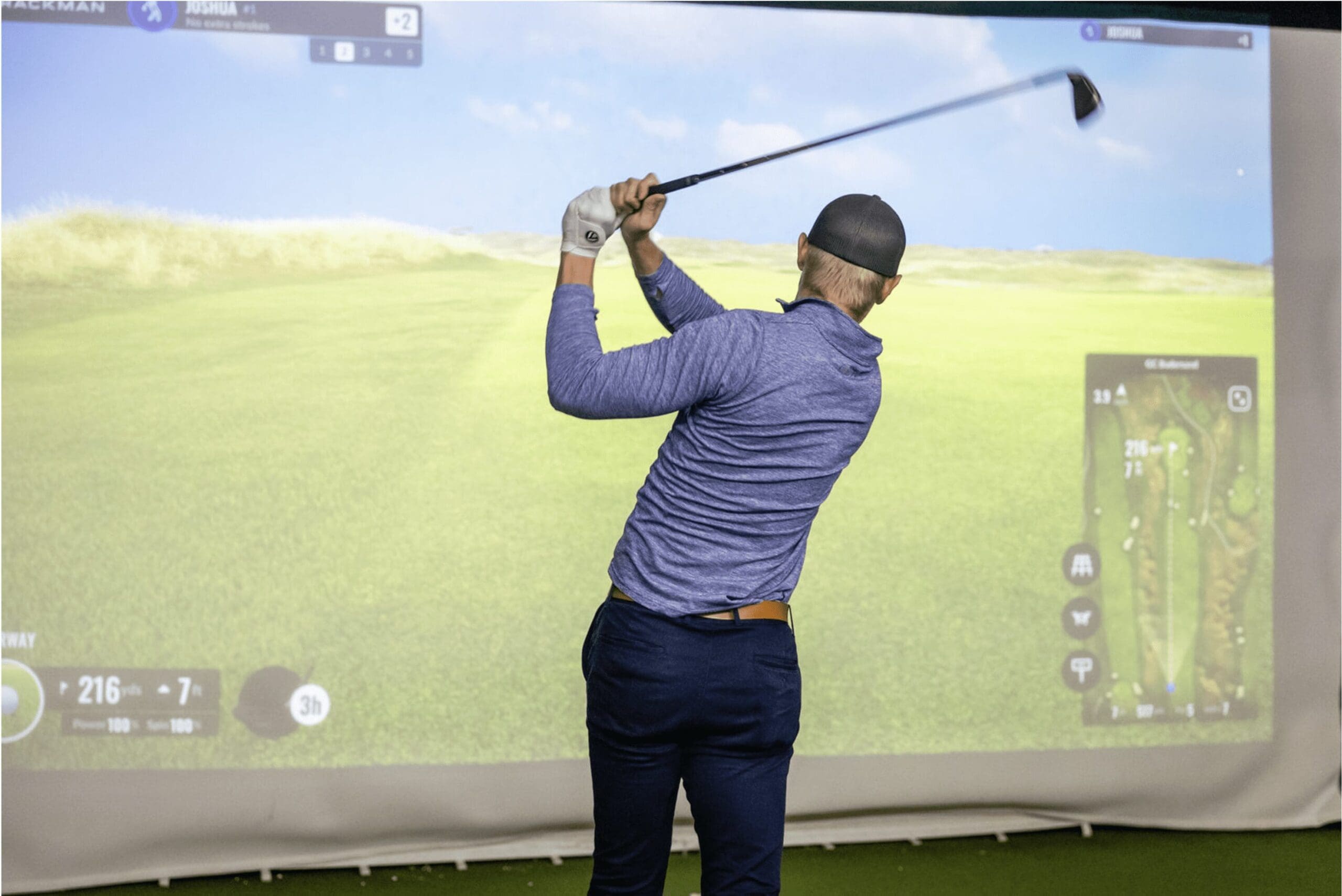

When November hits Northeast Ohio and temperatures drop below 40 degrees, where do serious golfers go to maintain their game? For Cleveland golfers who refuse to let winter derail months of progress, the answer isn’t simple. The debate between golf simulators and driving ranges has divided the local golf community, with passionate advocates on both sides.
The choice between a golf simulator and driving range for Cleveland winter training depends on your specific goals, budget, and what aspects of your game need the most attention. While driving ranges offer the feel of hitting real balls outdoors, indoor golf simulators provide detailed data analytics and climate-controlled comfort that traditional ranges simply can’t match.
In this comparison, we’ll examine the pros and cons of each option specifically for Cleveland’s winter conditions, analyze the costs, explore which training method delivers better results for different skill levels, and help you determine which option aligns with your golf improvement goals this off-season. [1] Whether you’re trying to lower your handicap, maintain consistency, or just stay sharp until spring, understanding these differences will help you make the most of your winter practice investment.
What’s better for winter golf practice: a simulator or driving range?
Golf simulators are generally better for winter golf practice in Cleveland because they provide:
Climate-controlled environment – Practice comfortably regardless of temperature or weather conditions
Detailed swing data – TrackMan and similar technologies offer immediate feedback on ball speed, launch angle, spin rate, and swing path
Full course play – Access to virtual rounds on famous courses, not just range practice
Year-round consistency – Same conditions every session, allowing for accurate progress tracking
Short game practice – Work on chipping, pitching, and putting in addition to full swings
Driving ranges offer the experience of hitting real balls and work well for golfers who prefer outdoor practice. However, Cleveland’s unpredictable winter weather, limited hours of operation, and lack of detailed performance metrics make simulators the more reliable choice for serious improvement during the off-season.
Why Cleveland Golfers Face Unique Winter Training Challenges
Northeast Ohio’s Weather Reality for Golfers
Let’s be honest about what Cleveland winters mean for your golf game. We’re not talking about mild Southern states where you can play year-round with a light jacket. Northeast Ohio weather creates real barriers to consistent practice.
- Average temperatures November-March: 20-40°F range
- Snow coverage limiting outdoor range access
- Reduced daylight hours (sunset by 5 PM in winter)
- Wind chill factors making outdoor practice uncomfortable
Cleveland averages over 60 inches of snow annually, which means outdoor ranges get buried regularly and need days to clear and dry out. The typical golf season here runs April through October – that’s only 6-7 months. If you’re serious about your game, that means nearly half the year without consistent access to outdoor practice.
The Cost of Losing Your Game Over Winter
Here’s what happens when you take 4-5 months off from golf: your game falls apart. Not a little bit. A lot.
- Skill regression during 4-5 month layoffs
- Muscle memory deterioration without consistent practice
- Starting each season “from scratch” with swing fundamentals
- Impact on handicap and competitive performance
- Lost investment in summer lessons and improvements
I’ve seen golfers come back in spring having lost 5-10 strokes off their handicap. They’re basically starting from scratch with swing fundamentals, re-learning what they already knew six months earlier. All that investment in lessons and practice during the season gets erased.
Now that we’ve explored Cleveland’s unique winter challenges, let’s examine how simulator technology addresses these specific issues…
Golf Simulator Training: Complete Analysis for Cleveland Players
How Modern Golf Simulators Work
If you’ve never used a golf simulator, the technology might seem complicated. It’s actually pretty straightforward once you understand the basics.
TrackMan technology and launch monitor systems use radar to track your ball from the moment it leaves the clubface. High-speed cameras capture your swing mechanics from multiple angles, recording every detail of your movement. Projection systems display realistic course play on a screen in front of you, making it feel like you’re actually playing at Pebble Beach or St. Andrews.
The real game-changer is the data. Every shot gives you immediate feedback on:
- Ball speed
- Launch angle
- Spin rate
- Club path
- Face angle
This immediate feedback loop accelerates improvement faster than traditional practice. Instead of guessing what went wrong with a shot, you know exactly what happened and can adjust accordingly.
The Clubhouse Cleveland’s Simulator Advantages
Located at 23800 Commerce Park Rd in Beachwood, The Clubhouse Cleveland offers professional-grade TrackMan systems in a climate-controlled environment. [2] You can practice comfortably year-round, regardless of what’s happening outside.
The facility provides flexible scheduling for busy professionals who can’t make it to outdoor ranges during limited daylight hours. Expert instruction is available during sessions if you want coaching alongside your practice. Your data tracks across multiple visits, so you can monitor improvement over weeks and months.
Statistics show that golfers who practice year-round retain muscle memory and consistency far better than outdoor-only players who take multi-month breaks.
Driving Range Training: Cleveland Options and Reality
Benefits of Traditional Range Practice
Despite the limitations, outdoor ranges do offer some advantages that matter to certain golfers.
- Real ball flight observation
- Authentic turf interaction and feedback
- Distance perception and trajectory visualization
- Outdoor environment simulation
- Often lower per-session costs
Watching an actual golf ball fly through real air, land on real grass, and react naturally gives you feedback that simulators approximate but don’t perfectly replicate. Some golfers simply prefer the authenticity of outdoor practice, even with the weather challenges.
Significant Limitations During Cleveland Winters
Here’s where outdoor ranges struggle during Northeast Ohio winters, and these aren’t minor inconveniences – they’re practice-killers.
Limited hours of operation mean you’re constrained by daylight. If you work a normal 9-5 job, winter range practice isn’t happening on weekdays.
Weather cancellations and unpredictability wreck any consistent training schedule. You plan to practice Tuesday and Thursday evenings, then snow hits Tuesday and the range is closed through Wednesday. Your routine falls apart.
Physical discomfort affects swing mechanics. When you’re cold, your body tenses up. Your grip pressure changes. Your rotation gets restricted. You’re not practicing your actual golf swing – you’re practicing a cold-weather survival swing that’s different from what you’ll use in comfortable conditions.
No detailed performance data or feedback means you’re guessing about what’s working. Did that ball fade because of your swing path, or because of the wind? You’ll never know.
Difficulty practicing in wind and cold affects technique in ways that don’t translate to better golf. You compensate for conditions rather than working on pure mechanics.
Short game areas are often closed or snow-covered during winter months, eliminating half your practice options. Range balls perform differently than premium balls, especially in cold weather when compression changes dramatically.
Head-to-Head Comparison: Which Training Method Wins?
For Skill Development and Improvement
When your goal is measurable improvement, the comparison becomes pretty clear.
Data-driven feedback advantage goes to simulators. You get instant metrics on every swing – ball speed, launch angle, spin rate, carry distance, dispersion patterns. This information is gold for making technical improvements.
Swing changes and technical work favor simulators because immediate metrics tell you whether adjustments are working. You make a change to your takeaway, hit five shots, and the data shows you exactly what effect it had on your club path and face angle.
Course management skills improve with simulators through virtual play on real courses. You can practice strategy, club selection, and shot shaping in realistic scenarios.
Real-world ball striking is the one area where driving ranges maintain an edge. Actually hitting balls outdoors gives you authentic feedback about contact quality and ball flight.
Winner: Simulators for measurable improvement. The feedback loop accelerates learning in ways that traditional range practice can’t match.
For Convenience and Consistency
This category isn’t even close.
Weather reliability: Simulators win with 100% uptime. Rain, snow, ice, extreme cold – none of it matters. Your practice schedule never gets cancelled.
Scheduling flexibility: Simulators offer extended hours beyond daylight constraints. You can practice at 8 PM in January just as easily as noon.
Session predictability: Simulators are never cancelled. You plan your week, book your times, and actually get to practice as scheduled.
Accessibility: Simulators in multiple Cleveland locations (like The Clubhouse Cleveland in Beachwood) make it easier to fit practice into your routine without long drives to limited outdoor facilities.
Winner: Simulators for consistent access. It’s not even a debate – reliability matters for building skills.
For Cost and Value
This comparison requires more nuance because the “cheaper” option isn’t always the better value.
Per-session costs at outdoor ranges run lower – typically $10-20 for a bucket versus $40-80 per hour for simulator time. But value per hour of quality practice tells a different story. An hour on a simulator with TrackMan data provides more improvement opportunity than two hours hitting balls with no feedback. You’re practicing more efficiently.
Long-term improvement ROI favors the method that actually improves your game faster. If simulator training drops your handicap three strokes over winter while range practice maintains status quo, the simulator paid for itself. Regular simulator users get significantly better per-hour rates with memberships, while casual practitioners might prefer pay-per-session at either facility.
Winner: Context-dependent. Serious, frequent practitioners get better value from simulators. Occasional practice or tight budgets favor ranges upfront.
Making Your Decision: Cleveland Winter Training Strategy
Questions to Ask Yourself
Before committing to either option, work through these questions honestly:
What specific aspects of my game need work? Technical swing changes with measurable feedback point toward simulators. Maintaining feel and working on tempo might work with ranges.
How often can I realistically practice this winter? Consistency matters more than method. If Cleveland weather limits outdoor visits to once or twice monthly, you need reliable simulator access.
Do I need professional instruction with my practice? Simulators pair well with coaching because data gives instructors precise information to work with.
What’s my budget for off-season training? Be realistic about total costs, not just per-session rates. Factor in drive time, cancelled sessions, and whether you’ll actually use what you pay for.
Do I value performance data and tracking? If you’re a numbers person wanting measurable progress, simulators provide information ranges can’t offer.
The Hybrid Approach
You don’t have to pick just one method for the entire winter. Many serious golfers use both strategically.
Use simulators for technical work and data analysis. Work on swing changes, dial in distances with each club, and practice course management through virtual rounds. Schedule occasional range sessions for real ball feel when weather permits. Even once or twice during winter helps maintain the sensory feedback of outdoor golf.
Balance costs with training goals. Maybe weekly simulator sessions and monthly range practice. Or intensive simulator work during brutal December and January, transitioning to more outdoor practice in March as temperatures rise.
Getting Started: Your Winter Training Action Plan
Ready to transform your off-season practice? Here’s your step-by-step approach:
1. Assess Your Goals Be specific about what needs work. “Get better” isn’t actionable. “Increase driver carry distance by 10 yards” or “reduce three-putts” gives you clear targets.
2. Try Before You Commit Schedule a trial simulator session at The Clubhouse Cleveland. Experience TrackMan technology firsthand and see your swing data. First-time visitors can book introductory sessions to test whether simulator training fits their learning style before committing to memberships.
3. Compare Your Options If possible, hit an outdoor range session too. [3] Feel the difference between simulator data and traditional range practice yourself.
4. Choose Your Plan Select the membership or session package that fits your schedule and budget. Be honest about how often you’ll actually practice. The booking process is straightforward – call (216) 450-6205 to schedule.
5. Start Training Consistently Begin regular winter practice and track improvement through spring. Consistency beats intensity – regular sessions produce better results than occasional marathon practices.
Ready to Get Started?
Don’t let another Cleveland winter set your game back. Year-round training keeps you competitive and builds on your summer progress instead of losing it.
Experience the difference: Call (216) 450-6205 now and book your trial simulator session
Ready to see how TrackMan technology and climate-controlled training can transform your winter practice? The Clubhouse Cleveland offers first-time visitors an introductory session to experience simulator training firsthand. Discover why Cleveland’s serious golfers choose indoor simulators over unpredictable outdoor ranges.
Contact The Clubhouse Cleveland:
📞 Call now: (216) 450-6205
📍 Visit: 23800 Commerce Park Rd, Suite M, Beachwood, OH 44122
🌐 Book online: theclubhousecle.com
Common Questions About Winter Golf Training in Cleveland
What’s better for off-season golf improvement: indoor simulators or outdoor driving ranges?
Indoor simulators work best for off-season golf improvement in Cleveland because they provide climate-controlled practice regardless of weather, detailed swing data through TrackMan technology, and consistent access that outdoor ranges can’t match during winter. We’ve seen golfers retain muscle memory and avoid the typical 5-10 stroke handicap loss that comes from taking months off. Simulators offer immediate feedback on ball speed, launch angle, spin rate and swing path, creating a faster learning loop than traditional range practice. For serious improvement during Northeast Ohio winters, reliable year-round access beats outdoor authenticity.
Where are the closest indoor golf simulator facilities in my area?
The Clubhouse Cleveland offers professional-grade TrackMan simulator systems at 23800 Commerce Park Rd in Beachwood. We provide climate-controlled training year-round with flexible scheduling for busy professionals. You can book introductory sessions to experience simulator training firsthand before committing to memberships. Contact us at (216) 450-6205 or visit theclubhousecle.com to schedule. The facility features expert instruction available during sessions, data tracking across multiple visits, and convenient access for Cleveland-area golfers looking for reliable winter practice options.
Resources
- https://www.golfdigest.com/story/winterize-your-golf-game
- https://www.trackman.com/blog/golf/top-8-ways-to-practice-indoors-with-trackman
- https://www.pga.com/story/practice-like-the-pros